Hearing is one of the first senses to develop in the unborn child, and it remains crucial to overall development during the early years of life. Healthy hearing development is closely linked to language, cognition and social interaction. This makes it all the more important to be aware of typical developmental milestones, to watch out for signs of problems, and for parents to actively support their child’s development. This is about how babies learn to hear, the role hearing plays in the first few months, and the options available for early intervention if auditory development is not progressing as expected for the child’s age.
Key Takeaways
- How does hearing development begin in the unborn baby?
- Hearing ability from birth: how newborns react
- Hearing and language development in the first year of life
- Milestones in hearing development in the first years of life
- Recognising potential hearing development disorders
- Tests and diagnostics: how hearing problems are detected early
How does hearing development begin in the unborn child?
From as early as the 20th week of pregnancy, the foetus reacts to sound stimuli. Although many sounds are muffled in the womb, voices, music and the mother’s heartbeat are clearly perceptible. The amniotic sac and amniotic fluid act as a natural filter, yet around 60 to 90 decibels still reach the unborn child. The mother’s voice, in particular, is recognised even before birth and has a soothing effect.
The inner ear is fully functional at this stage, the ear canal continues to develop, and the eardrum is in close contact with the middle ear. Even though the brain structures are still maturing, hearing is already actively involved in the unborn child’s experience.
Hearing ability from birth: how newborns react
Immediately after birth, the newborn begins to actively use its hearing. Many babies react to sudden noises with a startle reflex or turn their head towards the source of the sound. High-pitched sounds are usually preferred, particularly voices or gentle music. Hearing is not yet fully mature at this stage, but it is functional.
In the first month of life, the transmission of stimuli via the eardrum, middle ear and inner ear is already efficient. The brain begins to process auditory impressions, during which new neural connections are formed. This early phase is crucial for overall hearing development.
Hearing and language development in the first year of life
The link between hearing and speech development is particularly close in the first year of life. From as early as the second month of life, the baby babbles, imitates rhythms and recognises familiar voices. Between the fourth and sixth months, the first sequences of syllables such as “ba” or “da” emerge. The baby begins to distinguish between different sounds.
By the age of around nine months, many children can respond specifically to their name and recognise individual words. The development of speech comprehension thus begins long before the first spoken word. A prerequisite for this is a functioning hearing system that provides constant stimulation.
Milestones in hearing development during the first years of life
In the second year of life, vocabulary and language comprehension increase rapidly. The child responds to simple requests and understands contexts. Hearing ability becomes more refined, sounds are perceived with greater distinction, and attention to language increases.
Between the ages of three and five, auditory memory continues to develop. Children can imitate speech, repeat rhymes and even respond to quietly spoken cues. The sense of hearing is now an integral part of overall cognitive and social development.
Regular environmental stimuli - such as speech, music and everyday sounds - are particularly important during this period. Interaction with other children also promotes development in a natural way.
Recognising potential hearing development disorders
Age-appropriate hearing development requires that there are no functional or organic disorders. However, hearing impairments in early childhood are not uncommon. Causes may include conductive hearing loss due to repeated middle ear infections, malformations such as atresia or microtia, or genetically caused inner ear defects.
Parents should be alert if their child does not respond to voices or sounds, does not produce sounds, or if speech development is delayed. Constantly speaking loudly or a lack of reaction to environmental sounds can also be signs of hearing loss. In such cases, an early examination is crucial.
Examinations and diagnostics: how hearing problems are detected early
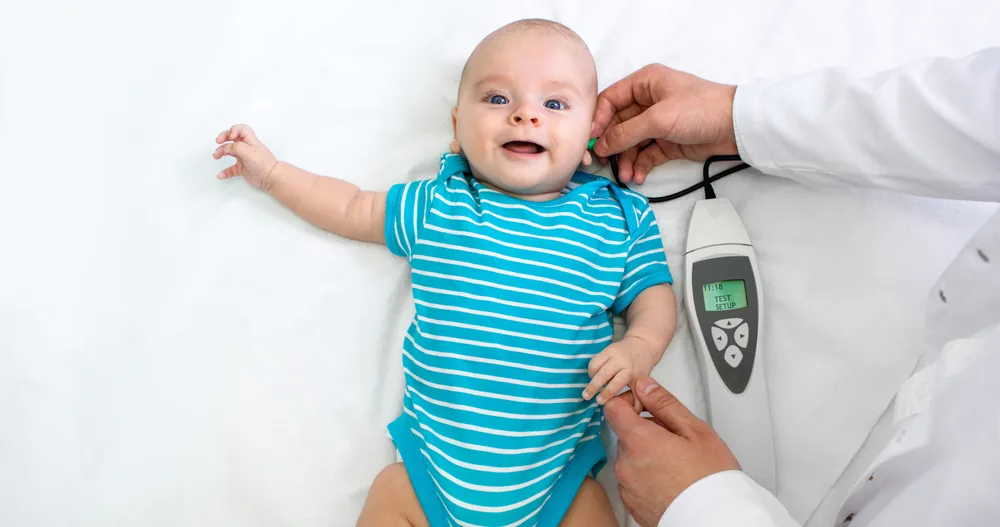
In Germany, a standardised hearing screening is carried out in the first few days of life. Methods such as otoacoustic emissions (OAE) or automated auditory brainstem response (AABR) are used to check the function of the inner ear and auditory nerve. If any abnormalities are found, further investigations are recommended.
In the months that follow, parents and paediatricians should keep an eye on the child’s hearing ability. If there are any concerns, child-friendly testing procedures at the ENT clinic can help measure the response to acoustic stimuli. Tympanometry or BERA tests provide more precise information about the cause of the hearing impairment.
Treatment and support for hearing impairments
If a hearing disorder is detected early, there is a good chance of providing targeted support for development. In mild cases, hearing aids that are individually fitted often help. In more severe inner ear defects, a cochlear implant may be fitted. The aim is to establish a stable hearing experience as early as possible.
In addition to technology, early intervention plays a vital role. Speech therapy, auditory training and targeted parental guidance help children to learn language and build social connections. The earlier treatment begins, the better the prospects for development.
How parents can contribute to hearing development
Parents play a central role in supporting their child’s hearing. A quiet, language-rich environment with a variety of auditory stimuli is ideal. Singing together, reading aloud, storytelling or engaging with music in a playful way stimulate auditory processing. It is also important to protect hearing from loud noises and, for example, to use ear protection at events.
Paying attention to reactions to sounds, voices and speech helps to spot problems early on. If you have any concerns, do not hesitate to consult a doctor. After all, a disorder detected early can be treated effectively today.