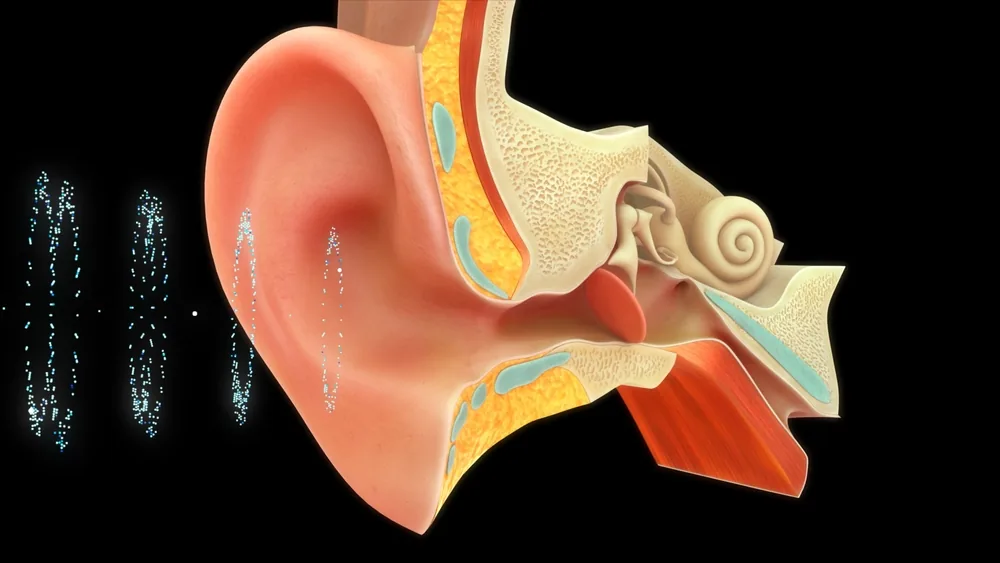
The outer ear is the visible part of our hearing system and also the first stage in the complex process of hearing. It picks up sound waves, transmits them and protects the more sensitive structures of the middle and inner ear. Yet although it is easily accessible from the outside, its importance and function are often underestimated. Discover how the outer ear is structured, what functions it performs and what typical conditions can occur in this area.
Key Takeaways
- What does the outer ear consist of?
- Structure of the outer ear, from the earlobe to the eardrum
- The function of the outer ear in the hearing process
- The outer ear, middle ear and inner ear: how they all work together
- Disorders and complaints affecting the outer ear
- Cleaning and caring for the outer ear
What does the outer ear consist of?
The outer ear comprises two key anatomical structures: the auricle and the external auditory canal. Both structures are directly visible or easily accessible and form the boundary to the middle ear, which is marked by the eardrum.
The auricle sits on the side of the skull and is unique to each individual. The external auditory canal connects the auricle to the eardrum. In medical terminology, the entire outer ear is also referred to as the auricula externa. It constitutes the first section of the hearing organ, even before sound is converted into mechanical or electrical signals.
Structure of the outer ear, from the earlobe to the eardrum
The auricle consists of elastic cartilage covered by skin. Its characteristic components include the helix, anthelix, concha, tragus and the earlobe (lobulus). The cartilage forms the complex shape that is crucial for sound reception.
The ear canal is a slightly curved passage with a cartilaginous outer section and a bony inner section. Along its length are sebaceous glands, hair follicles and ceruminous glands, which together produce earwax (cerumen). This serves not only to clean the ear but also to protect against bacteria, foreign bodies and drying out.
At the end of the ear canal lies the eardrum, which forms the boundary to the middle ear. It is paper-thin, flexible and is set into vibration by incoming sound waves.
Function of the outer ear in the hearing process
The outer ear’s role begins with the reception of sound. The auricle acts like a funnel, capturing sound waves and directing them into the ear canal. There, the sound waves are slightly amplified before they strike the eardrum.
Thanks to the specific shape of the auricle, we can perceive not only the volume but also the direction of sound sources more effectively. The ear canal, in turn, acts as a resonance chamber that amplifies frequencies particularly in the range of 2,000 to 4,000 hertz. This is crucial for speech comprehension.
Furthermore, the outer ear protects sensitive structures from mechanical stimuli, dust, insects and sudden temperature fluctuations.
The outer ear, middle ear and inner ear: how it all works together
The outer ear mechanically processes the sound. At the eardrum, the sound is converted into vibrations, which are transmitted via the ossicles in the middle ear - the malleus, incus and stapes. These set the fluid in the cochlea of the inner ear in motion.
In the cochlea, specialised sensory cells and hair cells respond to these vibrations and transmit them as electrical signals to the brain via the auditory nerve. Without the targeted pre-processing by the outer ear, this process would be less efficient and more prone to error.
At the same time, the outer ear is functionally linked to the vestibular system, even though this is located in the inner ear. Disorders of the outer ear can indirectly affect the transmission of vibrations and thus also the sense of balance.
Diseases and conditions of the outer ear
Typical conditions affecting the outer ear include, for example, inflammation of the ear canal (otitis externa), skin irritation, allergic reactions or blockages caused by earwax. Fungal infections or bacterial inflammation resulting from improper cleaning are also common.
Congenital malformations, such as a deformed antihelix or asymmetrical auricles, may be present from birth. In some cases, benign changes to the cartilage or injuries caused by pressure, cold or damage to the skin may also occur.
Pain, itching, hearing loss or the sensation of a ‘blocked ear’ are typical signs of problems in the outer ear. An accurate diagnosis by an ENT specialist is advisable to detect inflammation at an early stage and prevent it from progressing.
Cleaning and care of the outer ear
The outer ear is largely self-cleaning. Earwax is produced by the body and slowly transports dust, skin particles and small foreign bodies outwards. Using cotton buds carries the risk of pushing the earwax towards the eardrum, which can lead to blockages.
For care, it is sufficient to clean the outer ear with water and dry it with a soft cloth. If you experience discomfort, itching or suspect a blockage, you should refrain from attempting to clean the ear yourself. Instead, professional ear canal cleaning by a qualified practitioner is recommended.
Regular check-ups can be particularly helpful for hearing aid users, as the devices can cause more earwax to build up or lead to skin irritation.
The importance of the outer ear in hearing diagnostics and hearing aid fitting
The outer ear also plays a central role in medical diagnostics. During an otoscopy, the ear canal is examined using a special instrument. This allows inflammation, skin changes or foreign bodies to be detected.
In audiology, the shape of the outer ear is crucial for the positioning and function of hearing aids. The sound pickup by the device is based on the natural funnel effect of the auricle. Customised earmoulds are also fitted to take into account the natural shape of the ear canal.
Precisely because the outer ear is so easily accessible, its condition can be checked effectively - an important prerequisite for early diagnosis and targeted treatment.