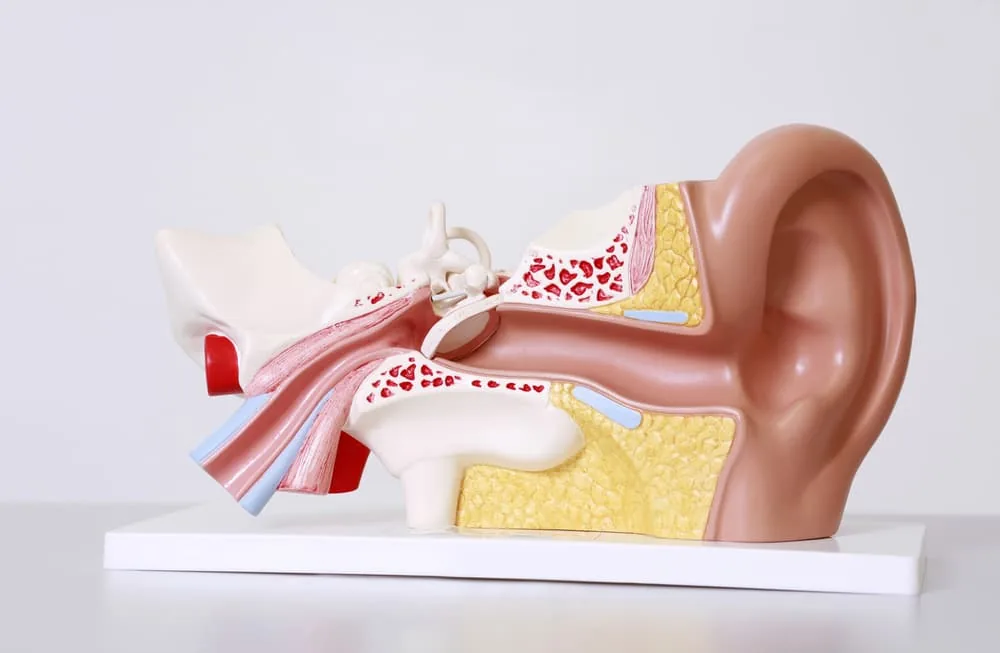
The middle ear is a key component in the auditory system. It transmits sound waves, equalises pressure differences and, at the same time, protects the delicate structures of the inner ear. If its function is impaired, this can have a direct impact on hearing and general well-being. Find out more here about the key aspects of the middle ear’s anatomy, functions and conditions.
Key Takeaways
- Anatomy of the middle ear
- Role of the tympanic cavity
- The ossicles and sound transmission
- The function of the Eustachian tube
- Common disorders of the middle ear
- Effects on hearing
Anatomy of the middle ear
The middle ear is situated between the outer ear and the inner ear. It begins at the eardrum and extends to the oval window of the inner ear. This space is known as the tympanic cavity and is filled with air.
The tympanic cavity contains three small, movable bones: the malleus (hammer), the incus (anvil) and the stapes (stirrup). Together, they form the so-called ossicular chain. This is lined with mucous membrane and plays a role in ventilation and self-cleaning. The tympanic cavity is connected to the nasopharynx via the Eustachian tube (tuba auditiva).
Role of the tympanic cavity
The tympanic cavity is not only an air-filled resonance chamber but also acts as a buffer against pressure fluctuations. Together with the Eustachian tube, it enables pressure equalisation between the middle ear and the outside world. This keeps the eardrum flexible and allows it to transmit sound vibrations unimpeded.
The ossicles and sound transmission
The ossicles in the middle ear function like an amplifier system for sound waves.
The malleus is connected to the eardrum and picks up its vibrations. These are passed on to the incus, which in turn sets the stapes in motion. The stapes transmits the vibrations to the oval window, a membrane that forms the passage to the inner ear. This mechanism enables low-loss transmission of airborne sound into fluid vibrations in the inner ear.
The function of the Eustachian tube
The Eustachian tube connects the middle ear to the throat. It is normally closed and only opens when swallowing or yawning. This allows air to enter the middle ear, ensuring effective pressure equalisation.
In children, the Eustachian tube is still short and tends to be oriented horizontally, which is why they are more susceptible to infections. Impaired ventilation can affect the function of the eardrum and increase the risk of middle ear infections.
Common conditions of the middle ear
The middle ear is a sensitive area that is frequently affected, particularly in children. The most common conditions include:
Acute middle ear infection (otitis media acuta)
This usually occurs as a result of an upper respiratory tract infection. Bacteria or viruses can enter the middle ear via the Eustachian tube. Symptoms include earache, fever, hearing loss and a feeling of pressure in the ear.
Chronic middle ear infection
If the acute inflammation does not clear up or recurs, it can lead to chronic inflammation. This carries the risk of permanent damage to the eardrum or the ossicular chain.
Serous effusion
Fluid builds up when fluid accumulates behind the eardrum. This is often caused by a blockage in the Eustachian tube. Sound is then transmitted less effectively, leading to temporary hearing loss.
Cholesteatoma
This is a benign but invasive growth of skin cells in the middle ear. It can destroy the ossicles and usually requires surgical removal
Effects on hearing
The middle ear plays a central role in sound transmission. As soon as this chain is interrupted by a disease or mechanical disturbance, it has a direct impact on hearing. Particularly in the case of a middle ear infection or fluid build-up in the middle ear, the path for sound waves is blocked. The ossicles can no longer move freely, and consequently less energy is transmitted to the inner ear.
In such cases, the condition is referred to as conductive hearing loss. It may be temporary, for example following an infection, or permanent, such as after untreated chronic inflammation. Sound reception is also impaired if the eardrum is damaged. The result is a muffled hearing sensation, in which particularly soft sounds or speech are difficult to perceive.
In children, recurring middle ear problems are often the cause of delayed speech development. This is because they cannot fully perceive the world through sound, which affects how the brain processes speech and sounds.
Diagnosis and treatment
Whether it is a mild inflammation or a more complex condition, an ENT specialist should be consulted if there are symptoms affecting the middle ear. A thorough examination usually begins with an otoscope. This allows the doctor to examine the eardrum and identify any abnormalities in the ear canal.
Tympanometry is often used if a middle ear effusion is suspected. This test measures the pressure in the middle ear and provides indications of ventilation problems or fluid build-up.
Treatment depends on the diagnosis:
- Acute middle ear infection: antibiotics, decongestant nasal drops, painkillers
- Serous otitis media: observation or, if symptoms persist, insertion of a ventilation tube
- Chronic inflammation or cholesteatoma: surgical treatment of the middle ear
- Eustachian tube dysfunction: physiotherapy (e.g. Politzer balloon), surgical intervention
In many cases, timely treatment is crucial to prevent permanent hearing damage. Children with frequent infections in particular should be checked regularly to ensure their hearing is developing appropriately for their age.
Interaction with the inner ear and brain
The middle ear is more than just a sound amplifier. It is an active link between the outside world and the sensitive inner ear. The mechanical movements generated in the eardrum are transmitted via the ossicular chain to the oval window. There, the inner ear, with its fluid, the perilymph, begins the conversion into nerve impulses.
These signals are transmitted via the auditory nerve to the brain, where they are interpreted as speech, music or sounds. If a disturbance occurs in the middle ear, the impulse is lost, and with it the auditory impression in the brain. This demonstrates how finely tuned the individual components of the auditory system must work together.
The vestibular system, located in the inner ear, is also closely linked to the middle ear, both functionally and spatially. Certain middle ear conditions, such as a cholesteatoma, can therefore also lead to dizziness or a disturbance of the sense of balance.