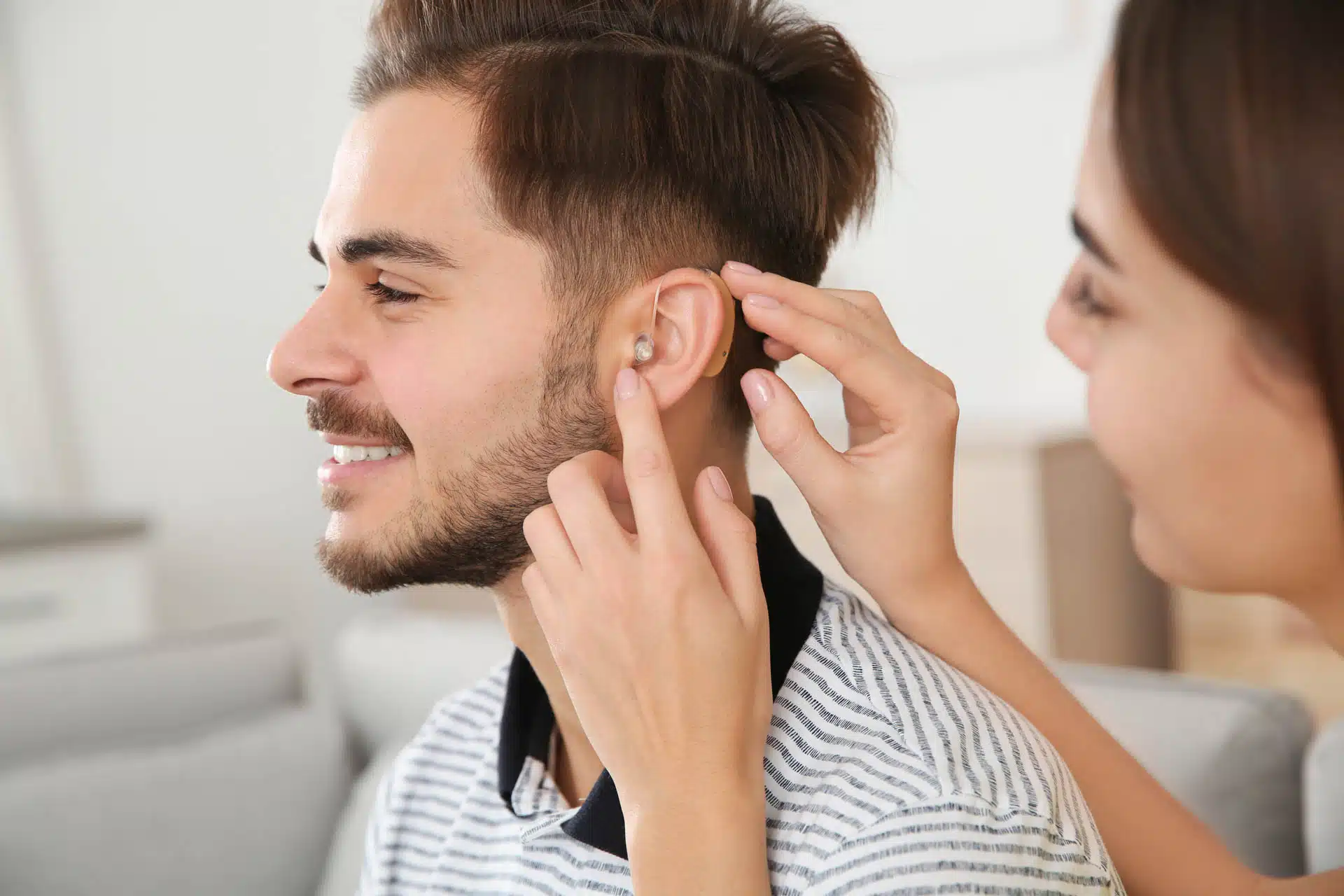
Communication lies at the heart of our daily lives - it connects us, enabling exchange and understanding. Yet for people with hearing loss, it presents an ever-present challenge. Here, modern assistive devices prove to be the key to participating in a society that is, in many respects, geared towards those with normal hearing. New technological advances are opening up new possibilities: from improved hearing aids to innovative communication aids.
Key Takeaways
- Hearing aids and how they work
- Specialised aids for the everyday lives of people with hearing loss
- The OSKAR TV audio amplifier
- Communication aids for people with hearing loss
- Assistive devices and technology for the working lives of people with hearing loss
- Aids for leisure activities and social interaction for people with hearing loss
Hearing aids and how they work
Hearing aids are highly sophisticated technical devices designed to meet the diverse needs of people with hearing loss and the deaf:
Behind-the-ear (BTE) hearing aids
These are ideal for a wide range of hearing losses, as they are placed directly behind the ear and effectively direct sound waves to the cochlea.
In-the-ear (ITE) hearing aids
Discreet aids that fit directly inside the ear and are specially designed for people with hearing loss who value discretion.
In-the-canal (ITC) devices
These tiny hearing amplifiers sit deep within the ear canal and are therefore ideal for active deaf and hard-of-hearing people seeking discreet solutions.
When selecting the right hearing aid, it is not only the degree of hearing loss and the condition of the cochlea that are relevant, but also comfort and personal preferences. A professional fitting is essential for people with hearing loss and the deaf, as only a perfectly tailored hearing aid can deliver the greatest benefit.
Hearing aids are highly sophisticated technical devices designed to meet the diverse needs of people with hearing impairments and those who are deaf:
Here are a few tips:
- Seek professional advice: An audiologist understands the complexity of the cochlea and can provide sound recommendations for people with hearing loss and the deaf.
- The proof is in the pudding: make use of trial periods to see how the hearing aid performs in everyday life.
- Ease of use matters: Choose a hearing aid that is easy to operate.
Specialised aids for the everyday lives of people with hearing loss
In everyday life, even seemingly minor incidents can pose major hurdles for people with hearing loss. To overcome these, specialised aids such as alarm clocks or vibrating alarm clocks and signalling systems are invaluable:
- Visual signalling systems:
Such systems are indispensable, as they convert sound signals into visual signals. For example, the ringing of a telephone is transformed into conspicuous flashes of light that can be perceived even out of the corner of the eye. - Vibrating alarm clocks and watches:
These devices ensure that you can start the day successfully even without an audible signal. Vibrating alarm clocks use strong vibrations, whilst other alarm clocks make waking up easier with flashes of light. - Doorbells for the hard of hearing:
A combination of light signals and vibration ensures that the doorbell is never missed. This means social visits and important deliveries do not go unnoticed. - Telephones for the hard of hearing:
Telephones for the hard of hearing are designed to improve audibility through amplification and to alert users to calls via flashing lights or vibrations. - Smoke alarms for the hard of hearing:
In the event of a fire, light signals and vibration units can save lives by warning the hard of hearing in good time and enabling them to react quickly. - TV aids and hearing amplifiers:
With special portable TV hearing amplifiers, TV headphones or chin-strap headphones, people with hearing difficulties can improve the sound from their television. These devices can transmit the sound directly to the user, thereby minimising background noise and enhancing sound quality.
The OSKAR TV hearing amplifier
With the OSKAR TV hearing amplifier from faller audio, you can easily bring the TV sound to your listening spot. And thanks to special speech optimisation, you can also understand dialogue on the TV better again.
Communication aids for the hard of hearing
Effective communication is crucial for getting to grips with everyday life and avoiding social isolation. Here are some communication aids that build bridges:
Text interpreters:
These services convert spoken language into text in real time, which is invaluable during lectures, conferences or in educational settings.
Sign language interpreters:
They are vital for communication in sign language and should be available at official events to ensure access to information.
Assistive technology:
Tools such as apps and devices that transcribe speech or convert text to speech provide enormous support for everyday communication.
Assistive technology for the working lives of people with hearing loss
The professional integration of people with hearing loss requires targeted measures and aids:
Workplace adaptations:
These include acoustic optimisations and special communication systems that enable equal participation in working life.
Assistive devices for meetings:
Technologies such as induction loop systems or special microphones make it easier to participate in meetings and conferences.
Legal support:
Knowledge of rights and funding opportunities is crucial to facilitating and promoting professional integration.
Assistive devices for leisure activities and social interaction for people with hearing loss
Leisure activities and social interaction enrich our lives and promote our mental well-being. For people with hearing loss, special aids and technologies are essential for this:
- Technology in social settings: Wireless transmission systems make it easier to follow conversations in groups or in noisy environments by transmitting sound directly to the hearing aid.
- Accessibility in public spaces: Public facilities and venues are upgrading to ensure inclusivity, for example through induction loops in theatres that transmit sound directly to hearing aid users.
- Adaptations for sport and leisure: Special headphones for swimming or protective cases for hearing aids during sport ensure that hobbies do not take a back seat.
Advice and support for people with hearing loss and their families
To navigate the jungle of technologies and aids, expert advice is essential:
Places to turn to for advice:
Specialist hearing aid shops, self-help groups and specialist social workers offer support and advice.
Funding for assistive devices:
Various organisations, such as health insurance funds and social services, may cover the costs. It is worth checking the options for cost coverage.
Sources of information:
Online platforms, forums and communities offer a wealth of information and personal accounts that help people with hearing loss make informed decisions.
FAQ: Frequently asked questions on assistive devices and technology for people with hearing loss
What types of hearing aids are available? There is a wide range of
hearing aids available for people with hearing loss, such as behind-the-ear devices, in-the-ear devices and in-the-canal devices. They utilise the cochlea’s ability to receive acoustic information and adapt this individually to the user’s residual hearing to enable improved hearing ability.
How can light signal systems and vibrating alarms support people with hearing loss in their daily lives?
Light signal systems help people with hearing impairments by converting acoustic signals, such as a ringing telephone, into visible flashes of light. Vibrating alarms and clocks ensure that users can wake up on time even without an audible signal, by using strong vibrations or flashes of light.
What specific communication aids are available for people with hearing difficulties?
For people with hearing difficulties, there are speech-to-text interpreters who convert spoken language into text in real time, and sign language interpreters who facilitate communication in sign language. In addition, technical aids such as apps and devices that transcribe speech or convert text into speech support the daily communication of people with hearing impairments.
How can we support people with hearing loss in the workplace?
In the workplace, acoustic improvements, induction loop systems and special microphones can help people with hearing loss, for example to participate in meetings. Knowledge of rights and support options is also important to facilitate and promote the professional integration of people with hearing loss.