Discernment loss describes a common but often misunderstood hearing problem: although those affected can hear sounds and noises, they have considerable difficulty understanding spoken language. Whilst volume is not an issue, distinguishing between similar-sounding speech sounds causes great difficulty. This comprehensive guide explains the medical background, causes, diagnostic options and modern treatment approaches for people with discrimination loss.
Key Takeaways
- What is discrimination loss
- Causes of speech discrimination deficit
- Professional diagnosis and assessment
- Difference between speech discrimination loss and AVWS
- Modern treatment approaches and hearing aids
- Significance for children and adults
Key points at a glance
- Discrimination loss affects speech intelligibility, not the perception of loudness
- The main cause is natural age-related hearing loss (presbycusis) due to the deterioration of hair cells
- Professional diagnosis is carried out using speech audiometry and the Freiburg Speech Test
- It differs fundamentally from auditory processing and perception disorders (APPD)
- Modern hearing aids with AI technology can significantly improve speech understanding
- A cure is not possible, but effective rehabilitation is achievable through hearing aids
What is discrimination loss
The term ‘discrimination loss’, also known as word comprehension loss or auditory discrimination disorder, describes a complex form of hearing impairment that goes far beyond a simple reduction in volume. Auditory discrimination represents the fundamental ability of the ear to perceive, compare and distinguish between different sounds and to understand their meaning. In the context of language, it is the ability to recognise the distinguishing features of individual phonemes as different. Phonemes are the smallest speech sounds that give words their meaning - for example, the ‘p’ in ‘Panne’ distinguishes the word from the ‘t’ in ‘Tanne’. People with this problem find themselves in the frustrating situation of being able to hear that someone is speaking, but unable to decipher the content of what is being said. A crucial aspect here is the distinction between hearing and understanding: a standard hearing test merely measures the hearing threshold, i.e. the quietest sound a person can hear. However, it often does not take speech comprehension into account. People with a loss of discrimination can hear all sounds, yet still have considerable difficulty deciphering speech, particularly in noisy environments or when there are several people speaking.Definition and distinction from hearing loss
At its core, discrimination loss involves an impaired ability of the ear and the brain to analyse and process the subtle nuances of speech. Whilst hearing appears to function normally and loud sounds are perceived without difficulty, the sounds heard can no longer be pieced together into intelligible words. This problem stems from an inability to recognise and correctly process subtle differences between individual speech sounds. Distinguishing this from conventional hearing loss is fundamental to understanding this condition: simple hearing loss is primarily a volume problem, measured in decibels. Soft or moderately loud sounds are either not heard at all or are perceived only faintly. Discernment loss, on the other hand, affects the clarity and comprehension of speech, measured as a percentage. A person affected might turn up the volume on the television, but the words still remain incomprehensible or unclear. This fundamental distinction also explains why people with speech discrimination loss often feel that the people they are talking to are mumbling or speaking unclearly. As there is no direct volume problem, those affected often do not recognise their issue as a hearing problem, which delays the search for professional help. The absence of obvious hearing loss can mean that the problem remains undiagnosed for a long time, exacerbating the social and psychological consequences.Typical signs in everyday life
The symptoms of discrimination loss are particularly evident in everyday communication situations and usually develop gradually over a long period of time. A common and early sign is difficulty following conversations in environments with background noise - for example, in restaurants, at parties, during social gatherings or over lunch with friends. The brain finds it increasingly difficult to separate the relevant speech signals from ambient noise. Another characteristic feature is the selective impairment of certain frequency ranges. Initially, the hair cells responsible for high-pitched sounds are often affected, meaning that high frequencies - such as those found in children’s or women’s voices, as well as in birdsong - become difficult or impossible to perceive. Over time, the problem can spread to affect lower frequencies as well, further exacerbating the loss of speech comprehension. Those affected repeatedly ask their conversation partners to repeat what has been said or to speak louder. This often leads to frustration on both sides, as the volume is not the actual problem. Distinguishing between consonants that sound similar, such as "p", "t", "f", "s", "b" or "d", becomes particularly problematic. These subtle differences between speech sounds are crucial for word intelligibility, but are no longer reliably recognised when there is a loss of discrimination.Psychosocial effects and consequences
Loss of speech discrimination is by no means merely a physical problem, but has far-reaching psychosocial effects that are often underestimated. The constant effort to decipher words and the feeling of being unable to keep up leads to uncertainty about one’s own hearing ability. Constantly guessing at words and the fear of misunderstandings can cause those affected to ‘switch off’ mentally and no longer actively use their remaining hearing. This withdrawal from conversations and groups can lead to a feeling of social isolation. Many people affected increasingly withdraw from social occasions, as these become too exhausting and frustrating. In some cases, these persistent communication problems and the associated loneliness can even increase the risk of depression. As hearing loss can also lead to reduced mental fitness, early intervention is crucial to maintaining quality of life, social participation and cognitive function. Treatment therefore aims not only to improve hearing through technical means, but also to restore self-confidence and active participation in social life.Definition and distinction from hearing impairment
Definition and distinction from hearing impairment
Typical signs in everyday life
Typical signs in everyday life
Psychosocial effects and consequences
Psychosocial effects and consequences
Causes of discrimination loss
The development of a loss of speech discrimination is based on various factors, which may occur individually or in combination. The causes range from natural ageing processes to external influences and specific medical conditions. A sound understanding of the underlying mechanisms helps in classifying and treating the problem.Age-related hearing loss as the main cause
By far the most common cause of discrimination loss is age-related hearing loss, medically known as presbycusis. This degenerative, irreversible process results from the natural wear and tear of the delicate hair cells in the inner ear, which are responsible for converting sound waves into electrical nerve impulses that are then transmitted to the brain. The hair cells responsible for high frequencies, located at the beginning of the cochlea, are particularly susceptible to wear and tear. These cells are exposed to normal noise levels on a daily basis and therefore wear out sooner than other areas of the inner ear. For this reason, high-pitched sounds such as vowels or sibilant consonants are often the first to be perceived incorrectly, which significantly impairs speech intelligibility. The ageing process of the ear begins at a young age, but usually only becomes noticeable from the age of 50 or 60. As we get older, the problem can extend to lower frequencies, further exacerbating the loss of speech comprehension. As age-related hearing loss develops gradually, those affected often unconsciously compensate for the impairment over a long period, meaning the problem is only noticed at a late stage.Noise-induced hearing loss
Alongside the natural ageing process, noise is one of the main causes of permanent hearing damage. A distinction is made between acute and chronic noise-induced trauma. A single, extremely loud event such as an explosion, a loud bang or attending a concert with sound levels exceeding 135 dB(A) can cause immediate and permanent damage. However, chronic noise exposure over years or decades is more common and socially significant. Even noise levels above 85 dB(A) can irreversibly destroy hair cells with prolonged exposure. Those particularly affected are people in noisy occupations such as agriculture, the construction industry, manufacturing, the armed forces, or the music and events sector. Acute noise exposure often initially leads only to temporary hearing loss, which can recover after 16 to 48 hours. However, gradual damage over many years often results in a very pronounced loss of speech discrimination. As the impairment progresses slowly, it is often only noticed at a late stage, which underlines the importance of regular hearing tests as a preventive measure. This also highlights the importance of hearing protection in noisy environments.Traumatic and disease-related damage
Acoustic trauma and noise-induced hearing loss are among the most common acquired causes of loss of sound discrimination. Prolonged exposure to loud noises or acute noise trauma can cause irreversible damage to the sensitive hair cells in the inner ear. This specific damage leads to characteristic deficits in frequency perception, thereby impairing the ability to distinguish sounds. Various diseases can severely damage the auditory nerve and lead to significant loss of auditory discrimination. These include viral and bacterial infections such as rubella, measles or meningitis, which often leave irreversible damage. Ménière’s disease, which is associated with episodic vertigo and tinnitus, can also impair the ability to distinguish sounds. Chronic ear infections lead to structural changes through repeated inflammatory processes, which impair fine hearing. Systemic conditions such as circulatory disorders, cardiovascular disease or diabetes can also damage the delicate structures of the inner ear, thereby impairing hearing function. Other significant risk factors include prematurity, head trauma, lead poisoning, chronic nicotine use, sudden hearing loss and ototoxic medications, which can specifically damage the inner ear. Genetic factors also play an important role, as a hereditary predisposition to hearing problems and reduced ability to distinguish sounds can be passed on.Professional diagnosis and assessment
Accurate diagnosis of discrimination loss requires a comprehensive professional examination by a hearing care professional or ENT specialist. Whilst online hearing tests can provide an initial indication, they can never replace expert diagnosis, as they cannot fully capture the complex aspects of discrimination loss. A professional examination is of crucial importance, as it not only determines the extent of the impairment but also sets the course for optimal treatment.Speech audiometry and pure-tone audiometry
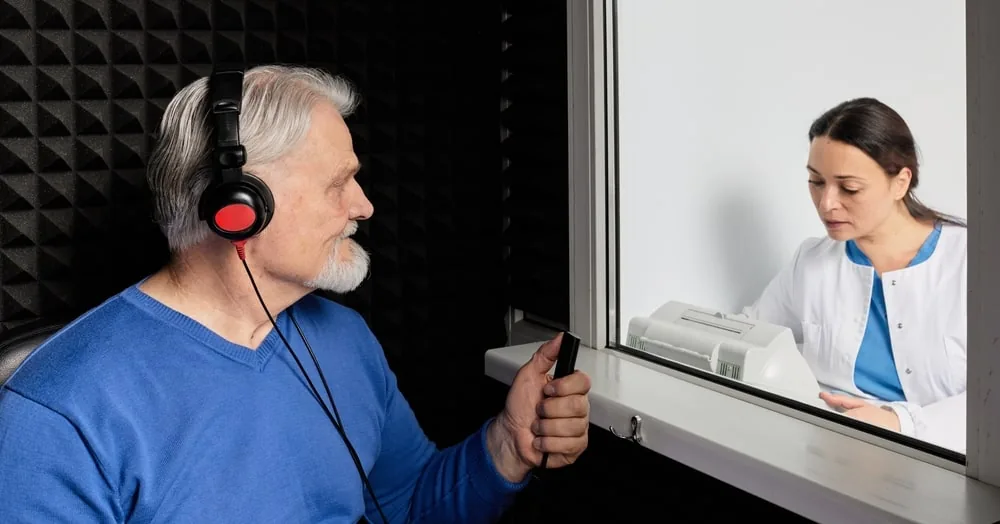
Professional diagnosis relies on two key measurement methods that complement each other and provide a complete picture of hearing ability. Tone audiometry determines the hearing threshold across various frequency ranges and measures how quiet a sound can be while still being perceived. This involves testing different frequencies, from low to high tones. The results are visualised in an audiogram and provide detailed information on the extent of hearing loss across the various frequency ranges. Speech audiometry, on the other hand, is the decisive test for speech understanding and thus the core of discrimination loss diagnostics. It measures the ability to correctly recognise and understand words, and is therefore directly focused on the core problem of discrimination loss. Whilst pure-tone audiometry shows whether and to what extent sounds are heard, speech audiometry assesses the practical application of hearing in everyday life. Speech audiometry employs various tests that assess different aspects of speech comprehension. These include tests using monosyllabic words, numbers or whole sentences. The tests are conducted at different volume levels to determine the optimal level of comprehension and to establish the volume at which satisfactory speech intelligibility is achieved.The Freiburg Speech Test
The Freiburg Speech Test has established itself as the gold standard for measuring discrimination loss. This standardised test can be carried out both in a quiet environment and in the presence of background noise, and is particularly relevant as it assesses the hearing aid’s ability to filter speech from background noise - one of the most important requirements in everyday hearing. During the test, the test subject is presented with standardised word lists, usually consisting of monosyllabic words, which are presented at a constant intensity. At the same time, the noise level can be gradually increased to simulate everyday listening situations and test hearing performance under realistic conditions. The test results are used to calculate the speech recognition score as a percentage, which represents the difference between perfect understanding (100%) and the actual percentage of correctly identified words. This specific metric enables a precise and objective assessment of the loss of discrimination as measurable hearing loss expressed as a percentage.Advanced diagnostic procedures and specialised tests
Further specialised tests are available for a comprehensive diagnosis, going beyond basic speech audiometry. The dichotic listening test is a particularly insightful examination method in which two different sounds or words are simultaneously sent to the left and right ears via headphones. This specialised test precisely demonstrates how well the brain is able to process complex auditory information and can provide important insights into central auditory processing. The word discrimination test in noise specifically assesses the ability to understand speech in noisy environments - one of the most important everyday challenges for those affected. In this test, two similar words are played against varying levels of background noise, and the test subject is systematically asked which word they heard. These tests simulate realistic listening situations and provide important insights into the practical implications of the discrimination disorder. Modern diagnostic procedures also include comprehensive sentence tests, in which whole sentences are presented against various types of background noise to better reflect real-life listening situations. These tests typically last around 30 minutes and provide detailed information about the patient’s specific difficulties. The World Health Organisation (WHO) classifies hearing loss according to the average hearing loss in decibels and refers to a hearing threshold of 35 dB or higher in the better-hearing ear as ‘disabling hearing loss’. This international classification aids in the standardised assessment of severity and the need for medical treatment.Difference between discrimination loss and AVWS
Although the symptoms of discrimination loss and an auditory processing and perception disorder (AVWS) may appear superficially similar, the crucial difference lies in the anatomical location of the disorder. This medical differentiation is fundamental to avoiding misdiagnoses and ineffective treatments and to providing those affected with the correct advice. Discrimination loss arises from damage to the peripheral hearing system, i.e. the inner ear or the auditory nerves. In this condition, the hair cells or nerve fibres responsible for processing certain frequencies are impaired or destroyed. As a result, the acoustic information reaches the brain in a faulty or incomplete state. The cause therefore lies in the ‘hardware’ of the hearing system. AVWS, on the other hand, is a disorder of the central auditory processes with completely intact peripheral hearing. Although the brain can receive the acoustic stimuli correctly, it is unable to analyse, filter or process them adequately. For this reason, a normal tone audiogram, which confirms intact peripheral hearing function, is an essential prerequisite for the diagnosis of AVWS. A loss of discrimination due to peripheral damage must first be ruled out. Treatment differs fundamentally as a result: whilst hearing aids that amplify and optimise the incoming signal are primarily used for a loss of discrimination, AVWS requires a multimodal approach involving speech and language therapy, specialised training measures and environmental adaptations. In children, AVWS often manifests as difficulties at school when learning to read and write, as they struggle to recognise sounds they hear and associate them with written characters. They are more easily distracted in noisy environments and frequently require visual cues to understand spoken language.Modern therapeutic approaches and hearing aids
The most important thing for those affected to realise is that a loss of auditory discrimination is an irreversible process that cannot be cured. The therapeutic aim is therefore rehabilitation, i.e. the best possible improvement of remaining hearing ability and speech comprehension through the use of state-of-the-art hearing aids. Hearing systems have evolved from simple amplifiers into highly sophisticated, intelligent technologies that can significantly improve the lives of their users.Current hearing aid technology
Modern hearing aids have evolved from simple amplifiers into sophisticated, intelligent technologies that optimise and personalise the listening experience in real time. They are specifically designed to address the core issue of hearing loss - filtering speech from noise - and to improve speech comprehension even in complex listening situations. Modern hearing aids use artificial intelligence and advanced sensors to continuously analyse and assess the listening environment. They can specifically identify and selectively block out background noise whilst focusing on the current conversation. This enables them to make the desired conversations clearer, even in the most complex sound environments, such as a restaurant with many simultaneous conversations. Some of the latest systems even use 4D sensors to simultaneously take into account body movements, conversational activity and the sound environment. This enables them to recognise the wearer’s intentions and adapt seamlessly to changing listening needs without the need for manual adjustments. Specialised technologies such as binaural beamforming combine signals from four or more microphones to direct a very narrow auditory focus onto the speaker in front of the wearer. The intensity of this focus can be automatically adjusted depending on the noise level, effectively minimising distracting sounds from the sides and from behind.Improving speech intelligibility
Modern hearing aids rely on various specialised technologies to improve speech understanding. Speech recognition algorithms identify the direction from which speech is coming and adjust the microphone characteristics accordingly. This enables a better spatial perception of the listening environment and the ability to follow conversations that are not coming directly from the front. AI-driven environmental adaptation enables modern hearing aids to process sounds in real time and precisely tailor the sound to the situation at hand. The integrated situation recognition continuously analyses the listening environment and distinguishes between different scenarios such as quiet conversations, noisy restaurants, music or road traffic. Automatic optimisation takes place without manual adjustments and enables dynamic adaptation to rapidly changing environments. Nevertheless, personalisation via smartphone apps offers users additional control over their hearing experience. They can adjust the focus on speech in challenging situations themselves, select different hearing programmes for different environments, and even tailor the sound characteristics to their personal preferences. These technological advances have significantly improved the quality of life for people with hearing loss. Whilst a complete restoration of natural hearing is not possible, modern hearing aids can significantly improve speech understanding, restore social participation and boost the self-confidence of those affected.Individual fitting and success factors
The success of hearing aid fitting depends largely on individual fitting and professional support. Every case of hearing loss is unique, both in its severity and in the personal hearing needs of the individual. Successful fitting therefore requires a detailed analysis of the individual’s hearing situation and precise tailoring of the hearing aid technology to their specific needs. Getting used to hearing aids takes time and patience. The brain must learn to process and interpret the new acoustic signals. Regular follow-up appointments and adjustments are therefore essential for the long-term success of the fitting. Modern hearing care professionals work closely with their clients to find the optimal settings and continuously optimise the hearing aids.Significance for children and adults
Discrimination loss in children
The effects of a loss of auditory discrimination vary considerably between different age groups and require tailored treatment approaches.
In children, auditory discrimination is particularly important for linguistic and cognitive development. Even in early childhood, children can distinguish their mother’s voice from that of a stranger. This ability improves with age and literacy. Phonological awareness - a key prerequisite for learning to read and write - depends directly on auditory discrimination ability. Phonemic awareness, a subset of phonological awareness, encompasses the ability to hear, recognise and manipulate phonemes.
Symptoms of hearing problems in children can include difficulty following verbal instructions, being easily distracted, difficulty looking and listening at the same time, and sensitivity to loud or sudden noises. It is very important that children improve their hearing skills for recognising speech sounds before starting primary school.
Loss of auditory discrimination in adults
In adults, inadequate auditory discrimination can lead to deficits in fluent reading, full comprehension of speech and the grasping of nuances in meaning. The nerves responsible for hearing may cease to function if they are no longer active in the event of hearing loss. The ability to recognise sounds is beneficial for reading, speech comprehension (particularly during telephone conversations) and grasping nuances of meaning through the intonation of the voice.