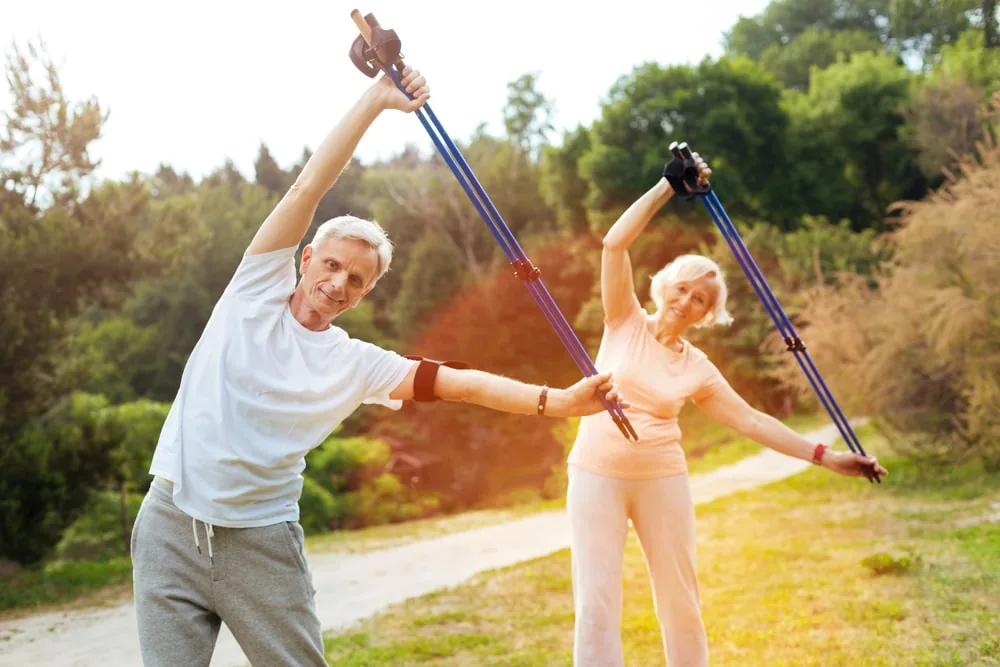
As we get older, the human body changes - this is a natural process. In particular, the loss of muscle mass and strength can significantly affect quality of life. Strength training in later life offers an effective way to counteract these changes and maintain physical fitness well into old age. Find out here about the importance of strength training for older adults and get practical tips on how to get started safely.
- Strength training counteracts natural muscle loss (sarcopenia) and can partially restore muscle mass that has already been lost
- Regular training strengthens bones and joints and improves balance, thereby reducing the risk of falls
- It is essential to seek medical advice before starting a training programme, particularly if you have any pre-existing conditions
- Training is possible both at home and at the gym - the key is performing the exercises correctly
- The WHO recommends that people aged 65 and over do at least three training sessions a week
- A balanced diet and sufficient recovery periods support training success
Why strength training is important in old age
Understanding natural ageing processes
The human body undergoes various changes over the course of a lifetime. From around the age of 30, a slow but continuous loss of muscle mass and strength begins. This process intensifies significantly with increasing age. From the age of 60, people lose on average around two per cent of their muscle mass per year - a phenomenon known in medicine as sarcopenia.
Impact on quality of life
These age-related changes have far-reaching consequences for quality of life. Everyday activities such as getting up from a chair, carrying shopping or climbing stairs become increasingly difficult. At the same time, the risk of falls and injuries increases as both muscle strength and
balance decline.
Strength training as a solution
Strength training offers an effective way to counteract these developments. Scientific studies show that targeted muscle training can still yield positive effects even in old age. Muscle cells retain their ability to regenerate and grow well into old age, meaning that older people can also benefit from regular
training and exercise as they age.
The onset and progression of muscle loss
The loss of muscle mass is a complex biological process that begins much earlier than most people realise. The first signs can appear as early as the late 20s if there is no regular physical activity. By the age of 80, muscle mass loss can amount to as much as 40 per cent.
Causes and contributing factors
Various factors contribute to this process. In addition to the natural ageing process, hormonal changes play an important role. The production of growth hormones, testosterone and other anabolic hormones decreases, whilst at the same time the concentration of stress hormones such as cortisol can rise, which promotes muscle loss.
Recognising warning signs
The first warning signs of progressive muscle loss often become apparent in everyday life. These include preferring lifts over stairs, needing to use support when getting up from a chair, or having difficulty lifting and carrying objects. These seemingly harmless changes can be indications of already advanced sarcopenia.
Reversibility of the process
The good news, however, is that this process is not irreversible. Targeted strength training can both prevent further muscle loss and partially restore muscle mass that has already been lost. Even in people over the age of 80, studies have shown significant improvements in muscle strength and mass.
Onset and progression of muscle loss
Onset and progression of muscle loss
Causes and influencing factors
Causes and influencing factors
Recognising warning signs
Recognising warning signs
Reversibility of the process
Reversibility of the process
Health benefits of strength training for older adults
Improving bone health
The positive effects of regular strength training go far beyond simply maintaining muscle mass. An important aspect is the strengthening of bone structure. Strength training acts as a mechanical stimulus on the bones and stimulates new bone formation. This can be particularly significant in preventing or slowing down osteoporosis.
Joint health and mobility
Furthermore, the joints benefit from regular exercise. Stronger muscles take the strain off the joints and, when performed correctly, can reduce joint pain. The improved blood circulation during exercise also supplies the joint cartilage with vital nutrients.
Improved balance and coordination
Another key benefit lies in the improvement of coordination and balance. Strength training not only works the muscles themselves but also the interaction between the nervous system and the muscles. This leads to better body control and can significantly reduce the
risk of falls - an important factor for safety in old age.
The metabolic effects of strength training are also noteworthy. Muscle mass is metabolically active tissue that consumes energy even at rest. Greater muscle mass therefore leads to a higher basal metabolic rate and can aid weight management. Furthermore, strength training improves insulin sensitivity and can reduce the risk of type 2 diabetes.
Mental benefits and quality of life
The mental health benefits should not be underestimated either. Regular exercise can boost self-confidence, improve mood and contribute to a sense of self-efficacy. Many older adults report an increased sense of well-being and greater enjoyment of life through regular physical activity.
Basic rules for safe exercise in older age
Medical advice before starting exercise
Safety is the top priority when it comes to strength training in older age. It is essential to consult a doctor before starting any exercise programme. This is particularly important if you have existing conditions such as cardiovascular problems, high blood pressure, diabetes or other chronic conditions. Your doctor can assess individual risk factors and provide recommendations for safe exercise.
Structured training programme
A structured training programme is essential. Beginners should start with light weights or even just their own body weight and gradually increase the load. Correct execution of the exercises takes precedence over intensity. Incorrect technique can lead to injuries and reduce the benefits of training.
Warm-up and stretching
Warming up before training and stretching afterwards are important components of every training session. A five- to ten-minute warm-up prepares the muscles, joints and cardiovascular system for the upcoming exertion. Light movements such as arm swings, squats without weights or walking on the spot are suitable warm-up exercises.
Recovery and rest
Recovery between training sessions is just as important as the training itself. Older people usually need 48 to 72 hours of rest between intensive strength training sessions targeting the same muscle groups. During this time, the body repairs and strengthens the stressed structures - a process that takes longer as we age.
Pay attention to your body’s signals
Listening to your body’s signals is crucial. Normal muscle strain is very different from pain that could indicate injury or overexertion. If you experience unusual pain, dizziness or other symptoms, you should stop training and seek medical advice if necessary.
Suitable exercises for older people
Bodyweight exercises
The choice of exercises should be based on individual abilities and goals. For beginners, bodyweight exercises are often a good place to start. Squats are among the most fundamental exercises, as they work the major muscle groups of the legs and glutes. They can initially be performed without additional weight and, if necessary, supported by holding onto a stable object.
Wall push-ups are a gentler alternative to conventional push-ups and work the arm, shoulder and chest muscles. This involves pressing against a wall with outstretched arms, with the distance from the wall determining the intensity.
Core training and stability
Modified planks or forearm planks are suitable for core stability. These can initially be performed on a raised surface such as a bench to reduce the intensity. Strong core muscles are important for good posture and can help prevent back pain.
Balance and equilibrium exercises
Balance training should not be neglected either. Simple exercises such as standing on one leg or walking along an imaginary line can improve balance and help prevent falls. These exercises can easily be incorporated into daily life, for example whilst brushing your teeth.
Exercises for people with limited mobility
For people with limited mobility, fall-prevention exercises can also be performed whilst seated. Standing up and sitting down on a chair without using your arms is an effective exercise for the thigh and gluteal muscles.
Training plan and frequency
Recommended training frequency
The World Health Organisation recommends that older people aged 65 and over undertake strength training at least three days a week. This recommendation is based on scientific findings regarding the optimal training frequency for maintaining and building muscle mass in older age.
Training structure and muscle groups
A typical workout should involve all major muscle groups. These include the leg muscles, glutes, core, back, chest, shoulder and arm muscles. It is not necessary to train all muscle groups in a single session - spreading them across different training days can be beneficial.
Intensity and repetitions
For beginners, two to three sets of 10 to 15 repetitions per exercise is a good guideline. The intensity should be chosen so that the last two to three repetitions are noticeably strenuous but can still be performed with correct technique.
Progression and progression
Progression, i.e. the gradual increase in training load, is important for continuous progress. This can be achieved by increasing the number of repetitions, adding extra sets or increasing the resistance. It is important that the increase is slow and controlled.
Training duration
A training session should last between 30 and 60 minutes, including warm-up and cool-down. Longer sessions can lead to fatigue and increase the risk of injury. Regularity is more important than the duration of individual training sessions.
Equipment and aids for strength training
Simple training equipment for home use
Strength training in later life does not necessarily require expensive equipment or a gym membership. Many effective exercises can be performed using simple aids or even without any equipment at all.
Resistance bands are versatile and cost-effective training aids. They are available in various strengths and allow for progressive training. Thanks to their compact size and light weight, they are ideal for training at home or whilst travelling.
Weights and dumbbells
Small dumbbells or weight cuffs offer the opportunity to intensify exercises. For beginners, weights between 0.5 and 2 kilograms are often sufficient. Water bottles can serve as a cost-effective alternative to dumbbells and allow for flexible weight adjustment through varying fill levels.
Equipment for balance and stability
Fitness balls, also known as exercise balls, are excellent for training core stability and balance. They can also be used as an unstable surface for various exercises, which helps to activate the stabilising muscles.
Professional training equipment
Specialised strength training machines are available for use in the gym, which guide movements and thereby reduce the risk of injury. These machines are particularly suitable for beginners, as they support the correct execution of movements.
Everyday objects as training aids
A sturdy chair is one of the most important ‘pieces of equipment’ for training at home. It can be used for support exercises, as resistance, or as an aid for balance exercises.
Strength training at home or in the gym
Advantages of home training
Training at home offers maximum flexibility in terms of time and location. It is cost-effective and allows for a relaxed atmosphere without social inhibitions. Many effective exercises can be performed in the living room or garden.
Disadvantages of home training
The main disadvantage of home training often lies in the lack of professional guidance. Incorrect execution of movements can lead to injuries or reduce the effectiveness of the workout. It can also be harder to maintain motivation at home, as there are numerous distractions.
Advantages of gym training
The gym offers the advantage of professional supervision and a wide range of equipment. Qualified trainers can monitor correct technique and create personalised training plans. The social aspect can also act as an additional motivator.
Disadvantages of gym training
Disadvantages of gym training include higher costs, fixed opening hours and potential travel distances. The psychological barrier to visiting a gym can also be high for some older adults.
Combined approach
A combination of both approaches can be ideal. Initially, professional guidance at the gym can help you learn the correct technique. This can then be practised independently at home. Many gyms offer special programmes for older adults and their health, tailored to the specific needs of older people.
The choice between home and gym training should ultimately depend on individual preferences, capabilities and goals. It is important that the chosen setting promotes consistency in training and can be maintained in the long term.
Nutrition and recovery
Protein requirements in older age
Strength training alone is not enough to achieve optimal results. A
balanced diet plays a crucial role in muscle building and recovery. A sufficient protein intake is particularly important, as proteins are the building blocks of muscle tissue.
Older people often have higher protein requirements compared to younger adults. Experts recommend around 1.2 to 1.6 grams of protein per kilogram of body weight daily for active older adults. Good sources of protein include lean meat, fish, eggs, dairy products, pulses and nuts.
Fluid balance and energy
Fluid intake must not be neglected. Sufficient water is important for metabolism, joint function and the regulation of body temperature. Older people often have a reduced sense of thirst and should therefore make a conscious effort to ensure adequate fluid intake.
Carbohydrates provide the energy needed for exercise and support recovery. Wholemeal products, fruit and vegetables are healthy sources of carbohydrates that also provide important vitamins and minerals.
The importance of sleep
Recovery is an active process that requires sufficient time. Sleep is of crucial importance here, as key repair and growth processes mainly take place during the night. Older people should aim for 7 to 8 hours of sleep per night.
Active recovery measures
Active recovery measures such as light walks, stretching or relaxation exercises can promote recovery and prevent muscle stiffness. Heat treatments or gentle massages can also be beneficial.