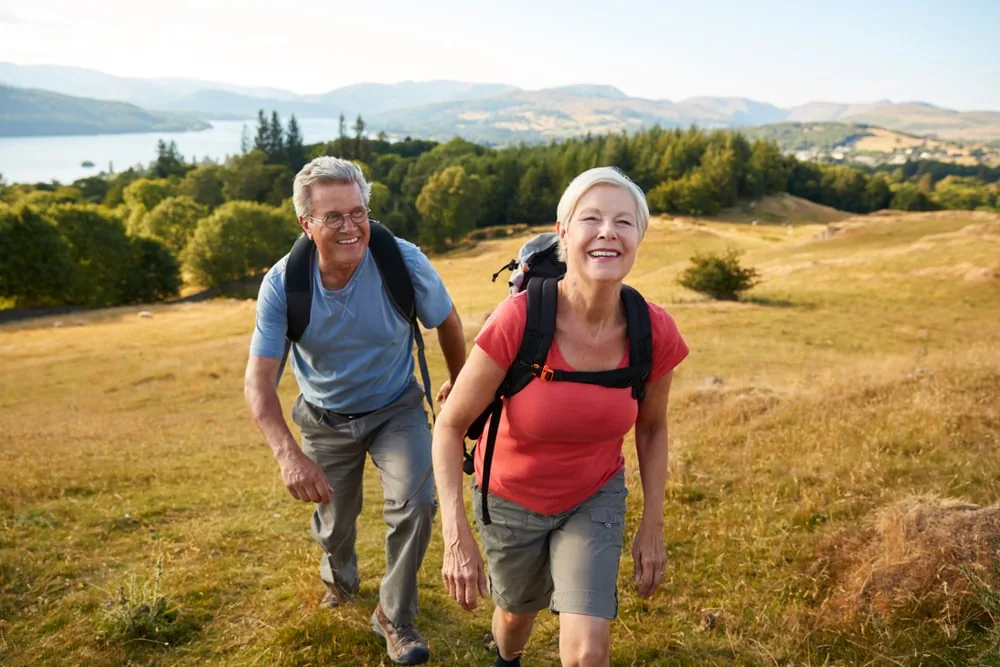
Hiking is one of the most popular leisure activities in Germany and offers an ideal way for older people in particular to stay active and enjoy the outdoors. Unlike many high-intensity sports, hiking can be flexibly adapted to individual abilities and can be taken up or continued even in later life. This activity combines physical exercise with mental relaxation and social interaction. Find out what older people should bear in mind when hiking, what good preparation looks like and what equipment is useful.
Key Takeaways
- Hiking is a joint-friendly activity that can be easily adapted to individual fitness levels and practised well into old age
- Thorough preparation, including a medical check-up and targeted training, helps to avoid overexertion and ensures you can enjoy the hiking experience
- The right equipment, particularly suitable footwear and walking poles, can enhance safety and relieve pressure on the joints
- Moderate routes with 300 to 500 metres of elevation gain per day and good infrastructure are suitable for beginners
- Spring and autumn often offer more pleasant hiking conditions than the height of summer
- Hiking in groups provides social interaction and increases safety on the trails
Why hiking is particularly valuable in later life
Hiking offers a variety of benefits that can be particularly important for older people. Exercise in the fresh air, the experience of nature and the ability to set your own pace make this activity an attractive form of physical exercise in later life.
Physical benefits
Regular hiking can help maintain physical fitness. The rhythmic movement of walking engages various muscle groups, whilst the strain is moderate compared to many other sports. In particular, the leg and core muscles are activated during hiking, which can contribute to stability and mobility in later life.
Walking on varied terrain also challenges the sense of balance, which plays a vital role in preventing falls in older age. Hiking trails, with their natural unevenness, offer gentle training for coordination. Endurance can be gradually built up through regular hikes without overloading the cardiovascular system.
Another aspect is the joint-friendly nature of hiking. Whilst jogging places considerable stress on the joints due to the impact of running, the load is distributed more evenly when hiking. This makes hiking a suitable option for people who rely on gentle forms of exercise. The gentle but continuous movement keeps the joints supple and can help prevent stiffness.
Mental and social aspects
In addition to the physical benefits, hiking also offers opportunities for mental relaxation. Being active in nature, far away from the stresses of everyday life, can contribute to inner peace. Focusing on the path, observing the surroundings and maintaining a steady pace often have a meditative effect. The fresh air and the experience of nature can help clear the mind and recharge your batteries.
Hiking can also foster social connections when done in groups. Hiking clubs and organised hiking groups offer opportunities to interact with like-minded people. Shared experiences of nature and conversations during the hike can strengthen a sense of belonging and counteract social isolation. For people who live alone, hiking groups can be an important source of community.
The sense of achievement when reaching a hiking destination or completing a more challenging route can boost self-confidence. The feeling of still being active and capable in later life often contributes positively to general well-being. Every hike successfully completed is a small victory over one’s own limits.
Physical benefits
- Maintaining and building leg and core muscles
- Joint-friendly exercise without impact
- Training of balance and fall prevention
- Gradual improvement in endurance and cardiovascular fitness
Mental benefits
- Stress relief and inner calm through experiencing nature
- Meditative effect of steady walking
- Social interaction and a sense of community within walking groups
- Boosted self-confidence through a sense of achievement
Proper preparation for hiking in later life
Careful preparation is the foundation for safe and enjoyable hikes. Both health considerations and a realistic assessment of one’s own abilities play an important role here.
Health check and individual requirements
Before starting regular hiking activities, particularly after long breaks or if you have existing health conditions, you should seek medical advice. This applies especially to people with cardiovascular diseases, joint problems or other chronic conditions. A medical assessment can help to realistically gauge your fitness level and identify potential risks.
Your individual fitness level forms the starting point for planning hikes. Those who have been relatively inactive should start with short, easy routes and only gradually increase the difficulty. Your daily form also plays a role; on days when you have less energy or are experiencing health issues, you should choose easier routes or allow for more frequent breaks.
Existing limitations such as knee problems or age-related hearing loss may require special precautions. In the case of hearing loss, for example, it can be important to be particularly alert on hiking trails in order to notice warning signals or other hikers in good time.
Training programme and fitness
A systematic training programme helps to build up the stamina and strength needed for longer hikes. A step-by-step approach is recommended for beginners: to start with, short walks of 30 to 45 minutes on flat paths are a good place to begin. After a few weeks of regular exercise, the duration and intensity can be gradually increased.
The frequency of hikes also plays a role. Two to three moderate hikes per week can be sufficient to improve fitness without overloading the body. Rest periods should be scheduled between hikes to allow muscles and joints to recover.
In addition to hiking, other activities can support your preparation. Light strengthening exercises for the leg muscles, balance training and stretching exercises can improve stability and help prevent injuries. Everyday activities such as climbing stairs or cycling also contribute to general fitness.
The best time of year for hiking
Choosing the right season can significantly influence the hiking experience. Spring and autumn are often considered particularly pleasant hiking seasons for older people. Temperatures are usually moderate during these months, making longer outdoor activities easier. In spring, nature comes to life, whilst autumn delights with its vibrant colours and crisp air.
The height of summer, with its high temperatures, can pose a particular challenge for older people. Heat puts greater strain on the circulatory system and increases the risk of dehydration. Those who still wish to hike in summer should opt for the early morning or late afternoon and take particular care to stay well hydrated. Shaded forest paths are often more pleasant than sunny high-altitude trails at these times.
Winter also offers opportunities for hiking, but requires particular caution. Snow and ice can make paths slippery, and the shorter days call for careful planning. However, winter hikes on cleared and gritted paths can be a special experience of nature.
Equipment and clothing for older hikers
Choosing the right equipment can make a significant difference to your comfort and safety whilst hiking. It doesn’t always have to be the most expensive products; what’s more important is that the equipment suits your individual needs and works reliably.
Footwear and clothing
Good footwear forms the basis of any hike. Hiking boots should have a non-slip treaded sole, offer sufficient support and be comfortable at the same time. For easy hikes on well-maintained paths, lightweight hiking boots or sturdy trekking shoes may suffice. On more challenging routes with uneven terrain, ankle-high hiking boots offer greater stability for the ankle and protect against twisting.
It is important to break in new shoes sufficiently before longer hikes. This prevents pressure points and blisters. The shoes should leave about a thumb’s width of space at the front, as feet slide forwards when walking downhill. Ideally, you should try them on in the afternoon when your feet are slightly swollen, to simulate the realistic conditions during a hike.
When it comes to clothing, the ‘layering’ principle has proven its worth. Several thin layers can be put on or taken off depending on the temperature and level of exertion. A breathable base layer wicks moisture away from the body, a warm mid-layer insulates, and a windproof and waterproof outer layer protects against the elements. You should always carry a hooded jacket, even if the sun is shining at the start. Technical clothing made from modern materials dries faster than cotton and can offer advantages in changing conditions.
Hiking poles and other aids
Hiking poles can be a valuable aid, particularly for older people. They relieve pressure on the knee joints when walking downhill, improve balance on uneven ground and distribute the load across the whole body. When walking uphill, they help to utilise the strength of the arms. Studies suggest that hiking poles can reduce the strain on the knee joints by up to 25 per cent.
The correct length of the walking poles is crucial. As a rule of thumb, when standing upright with the pole in your hand, your elbow should form roughly a right angle. Many modern walking poles are telescopic and can therefore be adjusted to suit individual needs. The length can be adjusted during the hike to suit different terrain: slightly shorter when walking uphill, slightly longer when walking downhill.
A well-fitting rucksack with a hip belt distributes the weight optimally and takes the strain off your back. For day hikes, a volume of 20 to 30 litres is usually sufficient. The rucksack should have padded straps and be adjustable to suit the individual. It is important that the weight does not become too heavy; as a guideline, around ten per cent of your own body weight is a good rule of thumb. Every unnecessary gramme means additional strain.
Essential kit also includes a water bottle or hydration system, food for the journey, a first-aid kit with personal medication, sun protection, a hat or cap, and a fully charged mobile phone for emergencies. A hiking map or a GPS device can help with navigation, even though many trails are well marked.
Footwear
Non-slip treaded soles and good grip are essential. Ankle-high hiking boots offer extra stability. Always break in new shoes before the trip.
Clothing
Layer up with a breathable base layer, a warm middle layer and a weatherproof outer layer. Technical fabrics dry faster than cotton.
Hiking poles
Reduce strain on the knee joints by up to 25 per cent, improve balance and distribute the load. Telescopic models are individually adjustable.
Rucksack
20 to 30 litres for day hikes, with a hip belt and padded straps. As a guideline, pack no more than ten per cent of your body weight.
Safety on hiking trails
Safety considerations should always be taken into account when planning and undertaking hikes. With the right preparation and a mindful approach, many risks can be minimised.
Route selection and difficulty levels
Choosing suitable hiking routes is crucial for a positive hiking experience. Well-marked circular trails with moderate gradients and a solid trail infrastructure are ideal for beginners. Many regions offer special themed trails or accessible routes tailored to the needs of older people.
Several factors should be taken into account when planning. The sheer length of the route is less significant than the combination of distance, elevation gain and the nature of the path. A flat route of ten kilometres can be less strenuous than five kilometres with steep gradients. As a guide for beginners, routes with 300 to 500 metres of elevation gain per day are considered manageable. More experienced hikers can gradually increase these figures.
The estimated walking time should also be calculated realistically, bearing in mind that older hikers often choose a more leisurely pace than younger ones. As a rule of thumb for planning your time: four kilometres per hour on flat paths, with an additional hour per 300 metres of elevation gain on ascents. Generous buffer times for breaks and unforeseen delays should be factored in.
The condition of the trail plays an important role in safety. Well-maintained paths with even surfaces are easier to walk on than narrow trails with roots, stones or slippery sections. Even trails that are normally easy to walk on can become slippery, particularly after rain. Information on trail conditions can often be obtained from local tourist offices or hiking clubs.
Accessible and low-barrier hiking trails
Hiking need not be ruled out by mobility limitations. More and more regions are offering accessible or low-barrier hiking trails that are also suitable for people using a walking frame, wheelchair or with reduced mobility. These trails are characterised by firm, level surfaces, moderate gradients and sufficient width.
Specialised hiking guides and online portals list accessible routes and provide detailed information on trail conditions, gradients and available facilities such as rest areas and toilets. The Brocken in the Harz Mountains, for example, also has an accessible circular summit trail that allows people with various mobility impairments to enjoy a mountain experience.
For people using walking sticks or walking aids, well-maintained paths with rest areas at regular intervals are ideal. The option to stop or shorten the hike at any time provides additional peace of mind.
Mountain railways as a convenient alternative
Mountain railways offer a practical way of reaching even more challenging hiking destinations. They cover the greatest differences in altitude and allow you to start the hike at the summit or at higher altitudes. The strenuous ascent is avoided, whilst the descent, often perceived as easier on the joints, can be made on foot.
Many alpine regions in the Bavarian Alps, the Allgäu or in Austria offer a well-developed network of mountain railways. The combination of a mountain railway ride followed by a hike to rustic alpine huts or vantage points is very popular with older hikers. This allows for impressive experiences of nature even when significant elevation gains can no longer be managed on foot.
Emergency preparedness and communication
Basic emergency preparedness increases safety whilst hiking. This includes ensuring that at least one other person is informed of the planned route and the expected return time. For longer or more demanding tours, it may be advisable to keep in regular contact.
Your mobile phone should be fully charged and within easy reach. Whilst mobile coverage is available in many hiking areas, there may be areas with limited reception. You should be familiar with the emergency number 112 for general emergencies and, where applicable, regional emergency services. In the event of an emergency call, precise details of your location are helpful; GPS coordinates or distinctive landmarks can be useful here.
A small first-aid kit can be helpful for minor injuries such as blisters, grazes or insect bites. You should carry a sufficient supply of any personal medication. People with known health risks may wish to carry a note containing important medical information.
The weather should be checked before every hike. If there is a risk of thunderstorms, strong winds or extreme temperatures, it may be advisable to postpone the hike or choose a more sheltered route. The season also affects conditions; in autumn and winter the days are shorter, and care should be taken to be back before dark.
Check and communicate your route in advance
Find out in advance about the route, difficulty level and terrain. Always inform at least one trusted person of your planned route and estimated return time.
Monitor the weather and remain flexible
Check the weather forecast before every hike. If there is a risk of thunderstorms or extreme temperatures, you should postpone the hike or choose a more sheltered route.
Always carry emergency equipment
A fully charged mobile phone, a small first-aid kit and any personal medication should be in every rucksack. Make sure you know the emergency number 112 and your approximate location.
Respect your own limits
Adjust your pace and route choice to how you feel on the day. It is not a sign of weakness to cut a hike short; your own safety always takes priority over reaching your destination.
Food and drink on the go
A sufficient supply of fluids and energy is important for your well-being during the hike. Older people in particular should make sure they drink and eat regularly, as the sensation of thirst is sometimes less pronounced in older age.
As a guideline, you should aim for around half a litre to a litre of fluid per hour of walking, depending on the temperature and level of exertion. On hot days, your needs may be significantly higher. Water or unsweetened teas are ideal. On longer hikes, an isotonic drink may also be useful, as it provides minerals as well as fluids. It is advisable to drink small amounts at regular intervals rather than waiting a long time and then consuming large amounts all at once.
For food, easily digestible, energy-rich snacks are suitable. Wholemeal bread with cheese or sausage, nuts, dried fruit, muesli bars or fresh fruit such as apples or bananas are practical options. These are easy to carry and provide energy without weighing heavily on the stomach. On longer hikes, several small meals or snacks spread throughout the day may be more sensible than one long break with a lavish meal. Any food you carry should be well packed to avoid crushing or leaking in your rucksack.
You can often stop off at mountain huts or inns along the hiking route. This offers not only an opportunity to refuel, but also to rest and socialise. When planning, however, bear in mind that not all huts are open all year round and some have closing days. Doing some research beforehand can help avoid disappointment.
Hiking in a group, social aspects
Hiking in a group offers practical advantages as well as social interaction. In many regions, there are hiking clubs or informal hiking groups that organise regular walks. These groups often cater specifically to older people and take their needs into account when planning routes.
Finding your way is easier in a group, as experienced hikers usually take the lead. A group also offers safety benefits; help is immediately available in the event of health issues or minor accidents. The pace is generally set so that all participants can keep up, and breaks are taken together.
Social interaction during the hike can enrich the experience. Conversations with other hikers, sharing observations of nature or laughing together at little incidents often make the tour an all-round positive experience. For people who live alone or whose social circle is limited, hiking groups can be an important source of community and interaction. New friendships often form during shared activities in nature.
Those who prefer to hike on their own can also set off with family members or friends. It is important that the pace and choice of route are tailored to everyone involved. Consideration and patience help ensure that everyone can enjoy the hike. Multi-generational hikes, where grandparents hike with their grandchildren, can create particularly wonderful experiences.
Hiking without luggage, travelling in comfort
For anyone wishing to undertake longer hikes lasting several days without having to carry heavy luggage, many tour operators and regions offer a special service: hiking without luggage. This involves having your main luggage transported from accommodation to accommodation, whilst you only need to carry a light day rucksack with the essentials.
This service significantly reduces the strain on your back, shoulders and joints, making even longer stages easily manageable. Luggage is usually collected from your accommodation in the morning and is ready at the next hotel or guesthouse by the afternoon. This allows you to enjoy the hike without a heavy load, without having to sacrifice comfort or a change of clothes.
Popular long-distance hiking trails with a luggage transport service include, for example, the Donausteig along the Danube, the Lechweg from the source to the Lechfall, the Sauerland Höhenflug or the Rheinsteig. This service is also offered in many other hiking regions. Bookings are usually made through specialist hiking tour operators, who also organise accommodation and provide maps.
Popular hiking regions for seniors
Germany and its neighbouring countries offer a wealth of beautiful hiking areas that are particularly suitable for older people. The choice ranges from gentle low mountain ranges to alpine regions with spectacular views.
The Bavarian Alps and the Allgäu between Berchtesgaden and Füssen are among the classic hiking regions. Here you’ll find countless routes of varying difficulty, often with the option of using mountain railways. Quaint mountain huts invite you to stop for a bite to eat, and the combination of mountain panoramas and alpine culture makes this region particularly charming.
The Harz, as the northernmost low mountain range, also offers a wide variety of hiking opportunities. The aforementioned barrier-free summit circular trail on the Brocken is just one example. The Harz Hexenstieg and shorter circular hiking trails through the characteristic landscape are also popular with older hikers.
The Black Forest, with its dense forests, sunny peaks and rustic landscapes, is a classic among German hiking regions. Its well-developed infrastructure and moderate altitude make it an ideal destination. The Sauerland also offers attractive options with the ‘Sauerland Höhenflug’ and other routes.
Beyond Germany’s borders, Austria’s Alpine regions, particularly Styria, beckon with stunning routes that can often be combined with wellness facilities at the accommodation. More southerly destinations such as the Italian volcanic island of Ischia or Lanzarote in the Canary Islands also offer interesting hiking opportunities, particularly in the cooler months when the climate there is more pleasant than in the Central European winter.
Bavarian Alps & Allgäu
A classic hiking region with alpine panoramas, rustic mountain huts and a well-developed network of mountain railways. Routes available for all levels of difficulty.
Harz
The northernmost low mountain range with a variety of trails, the accessible Brocken summit circular route and the popular Harzer Hexenstieg. Ideal for moderate hiking.
Black Forest
A classic destination with dense forests, sunny peaks and excellent infrastructure. Its moderate altitude makes it an ideal destination for older people.
Common challenges and solutions
Various challenges can arise when hiking in later life. However, with the right preparation and a few practical strategies, these can often be easily overcome.
Fatigue and a loss of strength can occur during a hike. Regular short breaks, during which you can have a drink and a small snack, help here. It is not a sign of weakness to slow down or take more frequent breaks; what is more important is that the hike is enjoyed overall. If you experience recurring severe exhaustion, you should reconsider your choice of route or consider training to improve your fitness.
Joint problems, particularly in the knees, are a common challenge. Walking poles can provide significant relief here. The choice of route also plays a role; long, steep descents put more strain on the knees than moderate inclines. If necessary, alternative routes, shorter distances or the use of mountain railways for the descent can be chosen. If symptoms persist, medical advice should be sought.
Difficulties with navigation can arise if markings are unclear or junctions are not clearly signposted. A hiking map, a GPS device or a hiking app on a smartphone can help here. It can be helpful to familiarise yourself with the map before the hike and note down landmarks. If you are unsure, it may be sensible to retrace your steps and find a familiar location, rather than continuing in the hope that the path will turn out to be the right one.
Sudden changes in the weather during the hike require flexibility. A waterproof jacket should always be in your rucksack, even if the sun is shining when you set off. If a storm is brewing, it is advisable to leave exposed areas such as peaks or ridges and seek shelter. If necessary, a hike can also be cut short; your own safety takes precedence over reaching the destination.
Feeling unsure on difficult terrain is normal and not a sign of weakness. At critical points, it can help to take your time, place each step deliberately and use walking poles if necessary. On challenging sections, there is no shame in being particularly careful or even sitting down to get past a difficult spot. Regular training of the leg muscles and balance in everyday life can improve sure-footedness.
Overall, hiking offers seniors a wide range of opportunities to stay active, enjoy nature and maintain social contacts. With the right preparation, suitable equipment, realistic planning and a willingness to listen to your own body, this activity can bring joy well into old age and contribute to your well-being. Every step taken in nature is a benefit for body and mind, regardless of how far or how high the hike takes you.