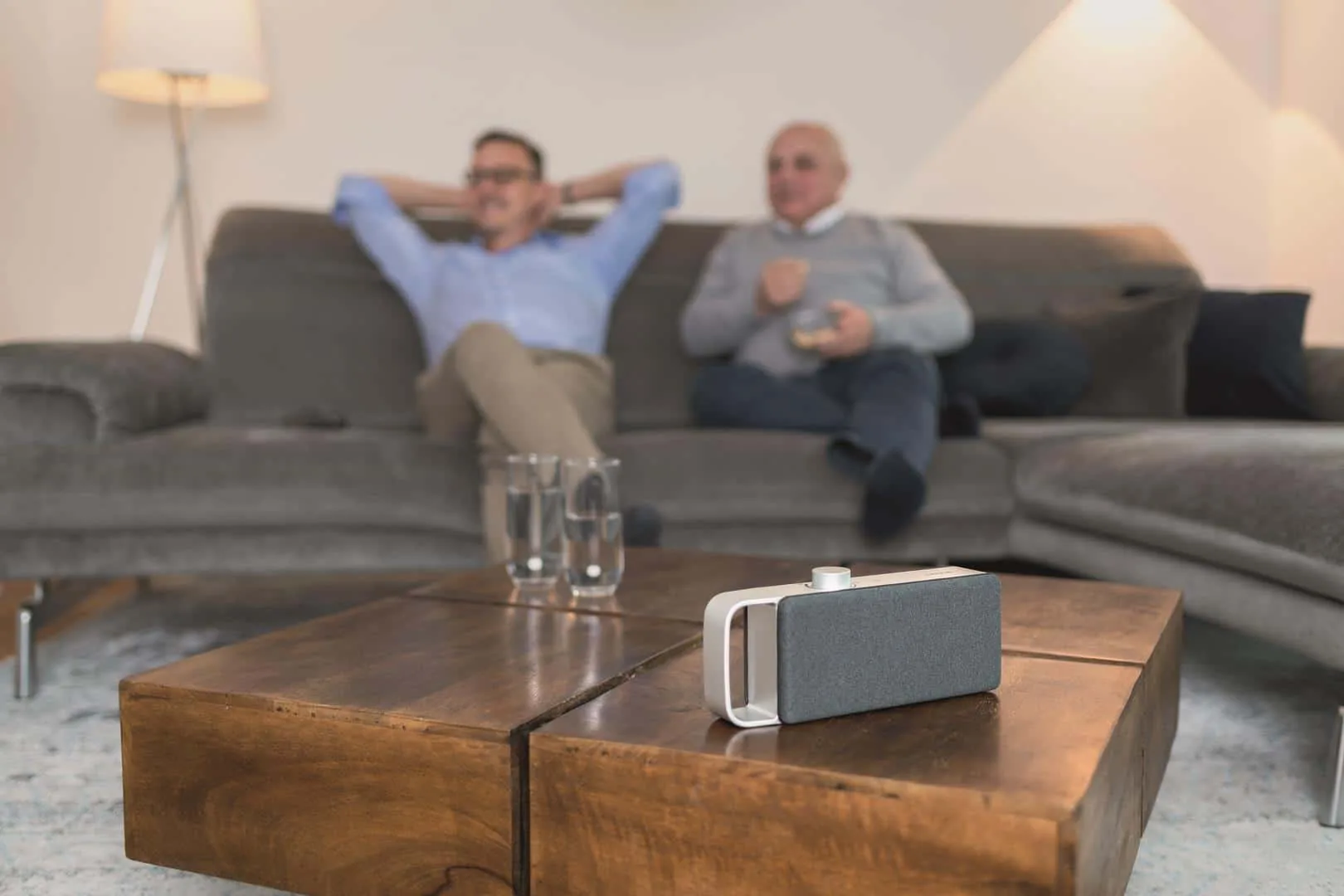
Compact speakers are a popular choice for those who want to improve the sound of their TV or music system without taking up too much space. These small and versatile speakers often offer adequate, if not outstanding, sound quality and are a viable solution for smaller rooms or for anyone looking for a compact, affordable alternative to larger speaker systems. Find out everything you need to know about compact speakers: from the basic features and what to look for when buying, to the question of when a device specialised in speech intelligibility makes more sense than a compact speaker.
Key Takeaways
- Compact speakers are space-saving external TV speakers that offer significantly better sound than built-in TV systems
- They improve dialogue clarity by emphasising mid-range frequencies and create a wider soundstage with stereo effects
- Various connection options available: HDMI, optical, Bluetooth, AUX and RCA for flexible device connectivity
- Easy installation and good value for money, but limited bass response without an additional subwoofer
- Stationary solution without a true surround sound experience - strategic placement required for optimal sound
- Devices specialised in speech offer additional mobility and targeted dialogue optimisation with dynamic sound adjustment
What are compact speakers?
Compact speakers are small, space-saving external TV speakers that often serve as a good solution for upgrading the sound of a television or music system. They offer improved sound quality compared to built-in TV speakers, yet take up significantly less space than floorstanding speakers or larger bookshelf speakers. These compact speaker systems are ideal for smaller rooms or living rooms where a rich, full sound is desired without the need for a large speaker cabinet. Their compact design allows for easy integration into a home cinema or music setup without compromising on sound quality.
Sound quality of compact speakers
The sound quality of compact speakers is significantly better than that of a TV’s built-in speakers. These external TV speakers offer a balanced soundstage that efficiently fills the room with sound. The improved reproduction of low frequencies and bass is particularly noticeable when watching films, TV series or listening to music, making compact speakers a suitable option for enhanced TV sound.
- Sound reproduction: Compared to a TV’s built-in speakers, compact speakers offer a clearer and more balanced sound. They are capable of producing sound across a wider frequency range, making high and low frequencies stand out more clearly. The difference is particularly noticeable in films or series with a lot of music and possibly many sound effects. Compact speakers can fill the room with sound more effectively without suffering from the sound distortion that can occur without external TV speakers.
- Dialogue: Compact speakers can, in some cases, improve the intelligibility of dialogue. Some models feature technology that helps emphasise the mid-range frequencies, which are crucial for voice reproduction. This ensures that speech remains clear and distinct even when music or sound effects are playing in the background. This is a significant advantage, particularly for films or series with complex sound mixes.
- Stereo effects and spatial sound: Although compact speakers do not offer a true surround sound experience due to their compact size, they are capable of producing decent stereo effects. These speakers simulate the impression that the sound is coming from multiple directions, creating a wider soundstage. For many users in smaller rooms, this is a good way to experience the sound as more pleasant and balanced.
- Dynamics and power: Another advantage of compact speakers is their ability to deliver greater dynamics and power. They are particularly useful when it comes to maintaining clear sound, even at higher volumes. During loud film scenes or music with many dynamic fluctuations, compact speakers provide the necessary power to reproduce the sound without distortion or loss of sound quality. Some models are also capable of integrating subwoofers to produce deeper bass and powerful dynamics.
- Rich sound: Compared to the small built-in TV speakers found in many televisions, compact speakers offer a fuller sound. Through the use of special speaker technologies and, in some cases, a subwoofer, the sound is enhanced, resulting in deeper bass and a more spacious sound. This ensures that the TV speakers can deliver a rich, full sound even in slightly larger rooms without losing any of the audio quality.
Features and models of compact speakers
Compact speakers are available in a wide variety of models offering different features. Most compact speakers are equipped with modern amplifiers that deliver high power and clear dynamics. Some models also feature subwoofers for improved bass reproduction, whilst others are fitted with high-quality tweeters that ensure particularly precise treble reproduction. In terms of connections, many compact speakers offer HDMI ports or optical inputs for easy connection to TVs, music systems or Bluetooth-enabled devices. They are a good choice for those who want to experience high-quality sound in small to medium-sized rooms without having to rely on large speaker cabinets.
What should you look for when buying a compact speaker?
When buying a compact speaker, there are a few key factors to consider to ensure the sound experience meets your personal requirements. First and foremost, sound quality should be a priority, particularly the speakers’ ability to reproduce dialogue clearly and deliver balanced bass. Some compact speakers also offer specific frequency range settings to adjust the sound depending on usage (e.g. for films or music). (However, this must be done manually.) Other important criteria include amplifier power, connections (e.g. HDMI ARC, optical inputs or Bluetooth) and compatibility with your existing TV or music system. For an optimal listening experience, it might also be worth choosing a model with a subwoofer to enhance the bass response.
Connections on compact speakers
The connections on compact speakers can vary, but they generally offer a variety of options to allow for easy connection to various devices. Common connections include:
HDMI: The HDMI (High Definition Multimedia Interface) connection enables high-quality digital audio and video transmission between the TV and external TV speakers. Particularly advantageous is HDMI ARC (Audio Return Channel), which allows the TV audio to be sent back to the speaker via the same cable. This connection reduces cable clutter and ensures simple and reliable integration, as it transmits both audio and video with excellent sound quality.
Optical input (Toslink): The optical input is a digital connection frequently used with external TV speakers to ensure lossless audio transmission. By using light pulses instead of electrical signals, the risk of interference that could affect sound quality is minimised. This connection is particularly valued when the TV and TV speakers are positioned far apart and stable, high-quality audio transmission is required.
Aux input (3.5 mm): The 3.5 mm aux input is an analogue connection available on many TV speakers, allowing for easy integration of external devices. Via this port, users can also connect their smartphone, tablet or other audio sources directly to the speaker. Although it is a simpler solution, sound quality may vary depending on the cable and device used, making it a less ideal choice compared to digital connections.
Bluetooth: The Bluetooth connection allows TV speakers to be connected wirelessly to smart TVs or other Bluetooth-enabled devices, thereby avoiding the need for additional cables. This technology is particularly beneficial for users who prefer a flexible and wireless solution for listening to TV sound through the speakers without any hassle. However, sound quality with Bluetooth connections can vary depending on the standard and the distance between devices, with newer Bluetooth versions (e.g. 5.0) offering a more stable and higher-quality transmission.
RCA connection: The RCA connection, also known as a cinch connection, is an analogue connection commonly found on older TV speakers. This connection consists of two separate cables used to transmit stereo audio signals. Although RCA remains a common option, it is increasingly being replaced by digital connections such as HDMI or optical inputs, which offer higher sound quality and a more stable transmission. Nevertheless, the RCA connection is still useful for connecting older devices to modern TV speakers.
These connection options ensure versatility and make it easy to connect compact speakers to various devices.
Advantages and disadvantages of compact speakers
Advantages:
- Space-saving: Compact speakers take up less space than traditional floor-standing or bookshelf speakers and are therefore ideal for smaller living rooms or spaces.
- Improved sound quality: They offer better sound quality and dialogue reproduction compared to built-in TV speakers.
- Easy installation: Compact speakers can be connected quickly and easily and are equipped with various connections such as Bluetooth, HDMI and optical inputs.
- Flexibility: They offer a good balance between performance and size, meaning they can be used in various living spaces.
Disadvantages:
- Limited bass reproduction: Without an additional subwoofer, the bass may be less powerful than with larger speaker systems.
- No true surround sound experience: Compact speakers do not offer true surround sound like larger surround systems or home cinema setups.
- Placement: Although compact speakers take up less space, they still need to be positioned strategically to achieve the best sound.
Compact speakers or a dedicated speech amplifier?
Compact speakers deliver a balanced sound for their size and are the right choice when music and films should both sound good. However, they usually stay in one place and treat speech like any other signal in the mix.
If the main concern is understanding dialogue on television, dedicated speech amplifiers such as the OSKAR by faller audio are an alternative. They emphasise voices specifically and are simpler to operate, but they offer less sound volume and are no substitute for good compact speakers when listening to music.