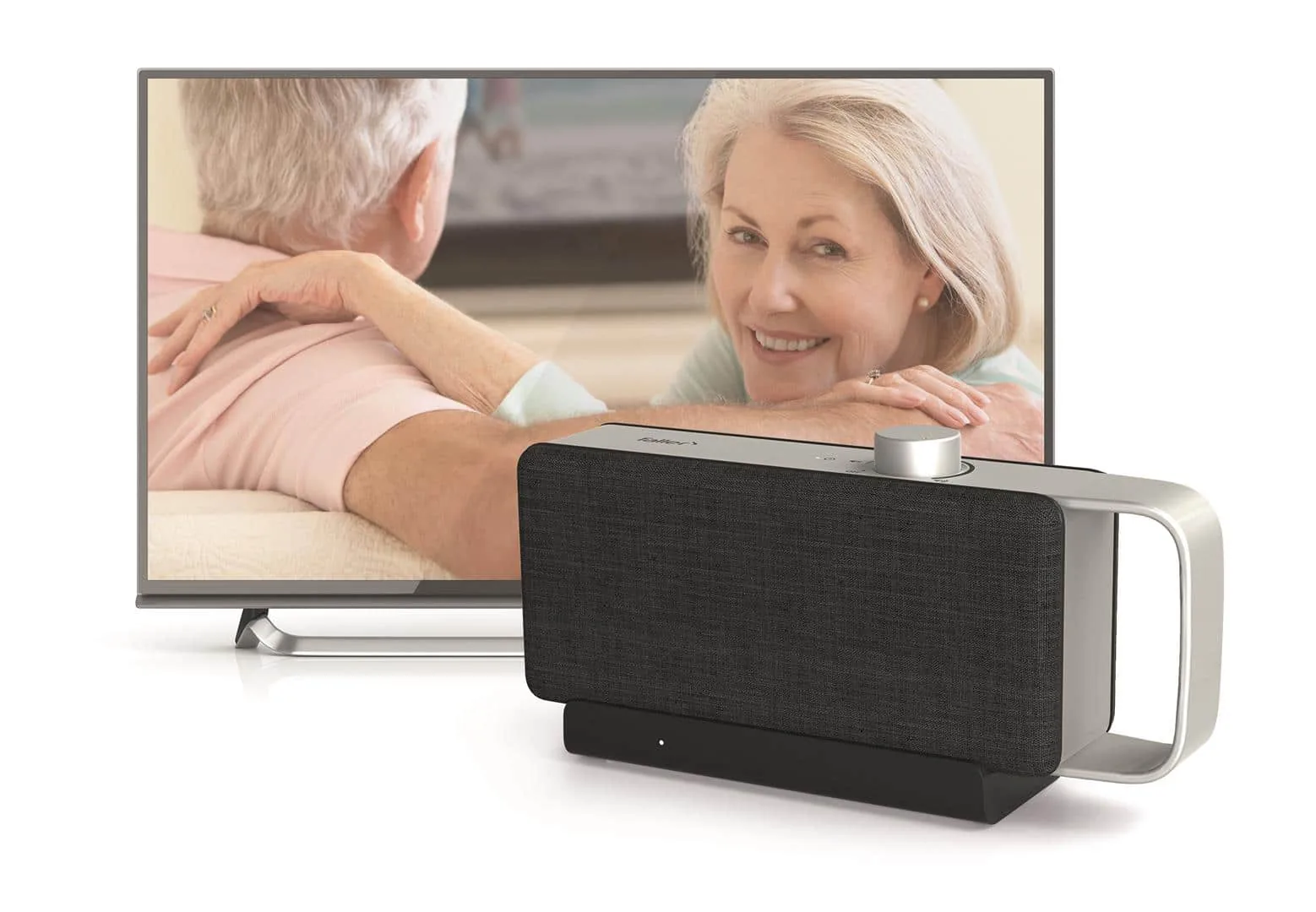
This section addresses the common challenges and solutions associated with TV speakers. We explore why the sound quality of modern televisions often falls short of expectations and what issues can arise with speech intelligibility and sound mixing. Furthermore, we highlight the benefits of external TV speakers and how specific solutions can help resolve common volume issues. Further detailed information can be found in the individual sections, which provide more comprehensive and in-depth explanations where required.
Key Takeaways
- Modern televisions are too thin for powerful built-in speakers
- Problems arise from poor speaker placement and compressed audio signals
- Room acoustics significantly affect sound quality
- External TV speakers improve speech intelligibility and sound volume
- People with hearing difficulties in particular benefit from specialised solutions
Why TV speakers
The sound quality of built-in TV speakers is often limited, as the trend towards ever-thinner televisions leaves little room for powerful speakers. This results in a flat and unbalanced sound that, in many modern televisions, fails to meet expectations for a high-quality audio experience. Lower frequencies, such as bass, are often not properly reproduced, which can lead to an incomplete listening experience, particularly with action films or music. Furthermore, on many TVs, the speakers are directed backwards or downwards, which further weakens the sound as it is not directed straight at the listener.
Another important factor affecting sound quality is room acoustics. Rooms with hard surfaces such as tiles or glass reflect sound and create echoes that can distort the audio. On the other hand, soft materials such as carpets and furniture absorb sound, which can impair the clarity of dialogue. Simple adjustments to the speaker position or additional acoustic measures such as carpets or curtains can significantly improve sound quality by distributing sound more evenly throughout the room.
Furthermore, the compression of audio signals in digital transmissions and streaming services often impairs sound quality. Compressed formats lose many details and nuances, resulting in less clear playback. Dialogue is particularly affected, as the subtle differences in speech are lost. The use of uncompressed audio formats or high-quality external sources can significantly improve sound quality in this regard.
The intelligibility of dialogue presents a further problem that is particularly noticeable in modern productions. In many films and series, sound effects and music are emphasised to such an extent that they drown out the dialogue. Furthermore, complex technologies such as Dolby Atmos can make it difficult to distinguish between dialogue and effects if the speakers or the mix are not optimally configured. External speakers or soundbars specifically designed to improve speech intelligibility can help to make the dialogue clear and distinct.
For many people, particularly older adults or those with hearing difficulties, watching television becomes a challenge as certain frequencies are hard to make out. Speakers tailored to individual hearing needs offer a solution here. These systems allow the sound to be optimised so that dialogue becomes more audible, significantly enhancing the viewing experience.
Although technologies such as Dolby Atmos are revolutionising the listening experience, they have their limitations. Particularly with complex soundscapes, it can be difficult to achieve a clear separation between dialogue and sound effects. Correct speaker setup and calibration is therefore crucial to fully benefit from the sound quality these technologies offer.
Another common problem with TV speakers is uneven volume. Fluctuations in volume between dialogue, music and adverts can be distracting for the viewer and mean the volume has to be constantly adjusted. Modern soundbars and speaker systems usually offer a feature that evens out these fluctuations and ensures a consistent listening experience.
Why am I having problems with my TV
Modern TVs offer impressive picture quality, but the sound quality often falls short of expectations. This is mainly due to the design of the sets. The built-in speakers are usually small and adapted to the flat design of the TV. The limited space for powerful speakers capable of reproducing low frequencies and bass results in a flat sound that is inadequate, particularly for dialogue or music, as well as for intense sound effects in films and series.
Another problem is the reduced sound quality caused by digital transmissions, which are common in many modern televisions. Compressed audio signals and bandwidth limitations diminish sound detail and are particularly noticeable during dialogue playback. This technical limitation means that the sound does not achieve the clarity and depth necessary for a good viewing experience.
The trend towards ever-thinner televisions also has a negative impact on sound. In the past, thicker models could accommodate larger speakers capable of producing a fuller and clearer sound. However, the trend towards ultra-slim devices has meant that acoustic performance suffers considerably. Particularly with modern Ultra HD and 4K televisions, which deliver incredible picture quality, sound quality is lost due to the flat design. Another structural issue is the positioning of the TV speakers. These are often directed downwards or backwards, meaning the sound is not aimed directly at the viewer. This results in a less precise, diffuse sound and reduces sound reproduction. The combination of these technical and structural challenges makes it clear why the built-in speakers in televisions are often insufficient to provide a truly impressive listening experience.
Challenges and solutions
Speech intelligibility in TV audio poses a challenge, particularly in modern productions where sound effects and music often overpower the dialogue. In action films or music-heavy series in particular, the spoken words fade into the background. This is especially problematic when the dialogue is difficult to understand, which is often the case with built-in TV speakers, as they do not allow for a clear separation between speech and other sounds. Another problem arises for people with hearing impairments, who struggle to hear certain frequencies, resulting in distorted or unclear sound.
The placement and type of speakers, particularly in slim-line televisions, also contribute to the sound being perceived as less direct and precise. External solutions such as soundbars can help here, as they are specifically designed to make dialogue clearer and better balance the sound. They offer features to enhance speech intelligibility and are able to optimise the sound mix between music, effects and dialogue.
Another common problem is the uneven volume between different formats such as films and TV series. In films, the sound is often louder and more dramatic, leading to volume fluctuations that make listening difficult. In adverts, too, the sound is deliberately mixed louder, resulting in jarring volume jumps. Modern speaker systems can compensate for these fluctuations, making the listening experience more pleasant and consistent.
The right audio equipment, particularly when equipped with technologies such as Dolby Atmos or special voice modes, can effectively address these challenges and significantly improve sound quality.
External TV speakers, such as soundbars, compact or standard speakers, or specialised speaker systems, offer a significant improvement in sound quality compared to built-in TV speakers. They deliver not only clearer and more precise dialogue, but also a wider soundstage and deeper bass frequencies, which are often lacking in flat-screen televisions. Particularly with complex soundscapes, such as those found in action films or music productions, the improved speaker placement and advanced technology ensure that the sound is reproduced more clearly and dynamically.
There are many advantages to external TV speakers. A key advantage is their versatility. They can be connected to various sources such as TVs, smartphones or tablets and often offer numerous connection options such as HDMI ARC, optical inputs or Bluetooth, which increases flexibility. Many models also offer features such as Dolby Atmos or DTS:X, which provide a spatial sound experience and give the feeling of being right in the middle of the action.
External speakers also offer improved volume and sound balance. By choosing the right speakers, unpleasant volume fluctuations between dialogue and background noise can be balanced out, which is particularly beneficial for people with hearing difficulties. Even in larger rooms or open-plan living areas, an external speaker system ensures that the sound is distributed evenly and with depth, making the viewing experience more enjoyable for all viewers.
Many TV viewers notice that the volume is often inconsistent across different TV programmes, platforms and formats. With streaming services such as Netflix, Amazon Prime Video, public broadcasters’ media libraries or various TV programmes, the volume varies due to different compression and audio formats. These differences lead to fluctuating sound quality and impair dialogue intelligibility. Streaming services, for example, tend to compress audio signals more heavily, which can lead to a loss of detail and clarity.
Modern televisions have volume controls that compensate for some of these fluctuations. This feature can be helpful in stabilising the volume during programme content and adverts, but it does not match the precision of an external speaker system or a TV speech amplifier. External solutions significantly improve speech intelligibility by emphasising frequencies that are important for speech, making dialogue clearer and easier to understand.
External TV speakers are particularly beneficial for users who wish to improve their television’s sound quality. They are especially valuable for people who regularly watch films or series and want clear dialogue reproduction as well as richer sound. These systems are also ideal for home cinema enthusiasts who want to add more depth to sound effects and music. A key advantage of external speakers is that they are also helpful for older people. Hearing often deteriorates with age, which makes it particularly difficult to understand dialogue. Especially with built-in TV speakers, which often struggle with higher or lower frequencies, dialogue frequently gets lost in the cacophony of music and sound effects.
External speakers, particularly those with a ‘dialogue mode’ such as the OSKAR TV speaker, offer a significant improvement here. These models emphasise the mid and high frequencies to enhance speech intelligibility, whilst reducing lower frequencies. The ability to customise the sound also helps to optimise the audio to suit individual needs. Furthermore, external speakers offer the advantage of directing the sound specifically towards the viewer, which is particularly beneficial for televisions with speakers facing downwards or backwards.
For older people living in smaller homes, compact external speakers offer a space-saving yet powerful solution. These not only improve sound quality but also make the TV viewing experience considerably more enjoyable and easier to understand for those with hearing difficulties. External speakers are therefore a worthwhile investment for anyone wishing to optimise speech intelligibility and the overall sound quality of their television.