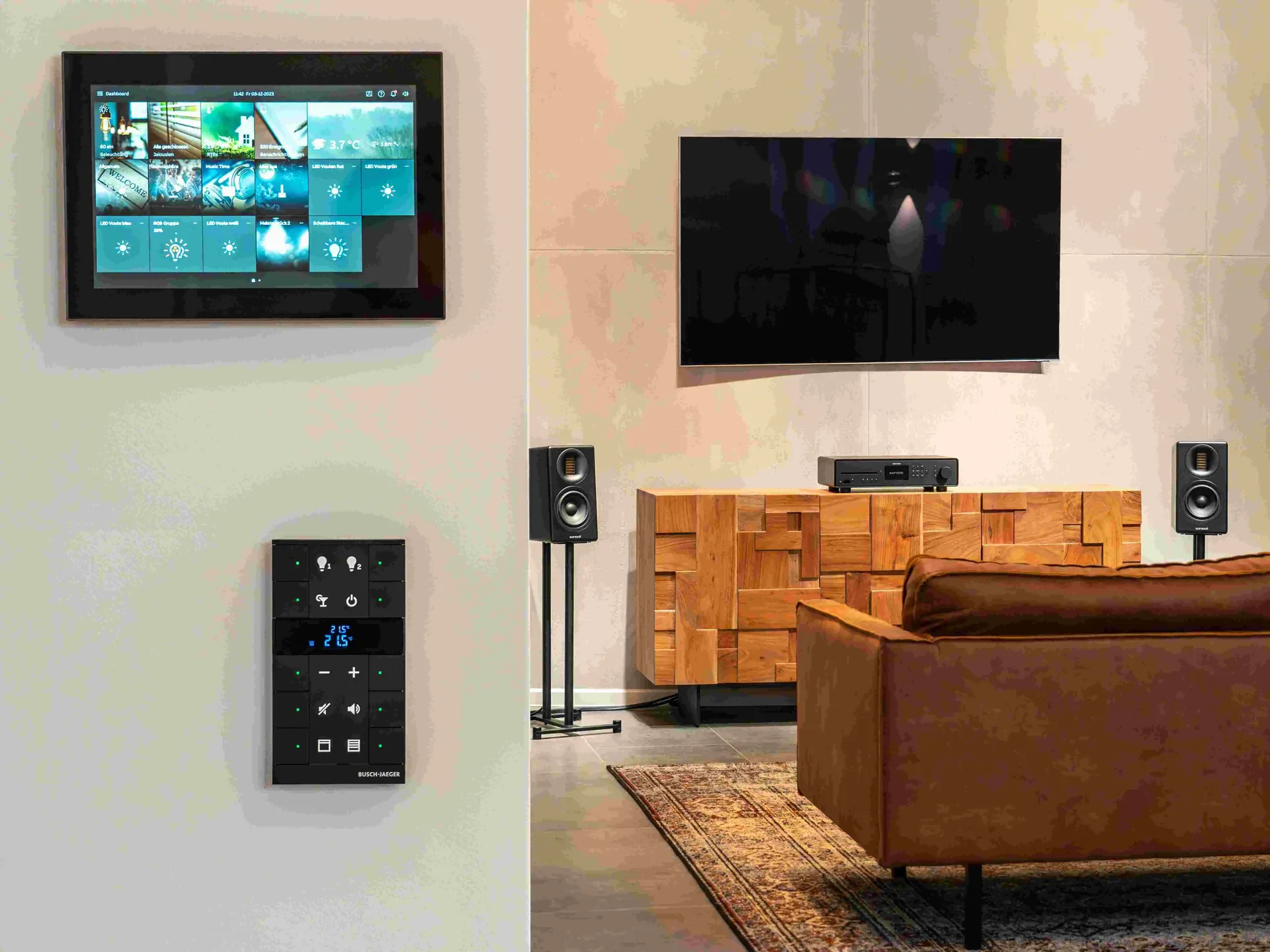
A smart home offers comfort, security and efficiency within your own four walls. Intelligent technologies allow household appliances, entertainment electronics and security systems to be connected and controlled centrally. This home automation not only revolutionises everyday life, but also offers sustainable solutions for saving energy. Whether it’s controlling lighting, heating or entertainment systems, a smart home is far more than just a technical luxury. It is a way to make life easier, safer and more comfortable.
Key Takeaways
- Smart home systems connect TV speakers to platforms such as Alexa, Google Home and Apple HomeKit - central control via apps or voice commands
- Entertainment scenarios such as ‘Movie Night’ automatically activate TV speakers, dim the lights and set the soundbar to the optimal sound mode
- Voice assistants enable convenient control without a remote control - simple commands for volume, sound modes and device activation
- Wi-Fi, ZigBee and Z-Wave ensure stable connections - mesh systems prevent dead spots and guarantee reliable communication
- Smart home apps offer centralised control and scenario creation - regular updates keep the system functional and compatible
- Home automation boosts energy efficiency through automatic device switching - TV speakers switch on and off as needed
Smart home systems
A smart home system connects various devices and applications, enabling centralised control. This technology makes it possible to enhance the comfort and efficiency of a home by allowing different devices such as lights, speakers, cameras and thermostats to communicate with one another. The heart of such a system is often a hub or an app that acts as a central control point. Through these platforms, the devices can interact with one another, allowing them to be conveniently controlled via a single interface.
Platforms such as Alexa, Google Home and Apple HomeKit are leading providers in the field of smart home technology and offer high compatibility between devices from different manufacturers. This means that not only devices from a specific manufacturer, but a wide range of brands and models can be connected to enable seamless control. This integration simplifies operation, as everything can be controlled from a single app or voice assistant, whether for controlling lights, regulating temperature or managing entertainment electronics.
Various transmission standards are used to ensure that devices can communicate reliably with one another. Wi-Fi, ZigBee and Z-Wave are commonly used standards that ensure a stable and reliable connection between devices. These technologies ensure that devices interact with one another without the connection becoming unstable or the range being too short. This creates a truly smart home in which all devices work in harmony and can be seamlessly integrated into everyday life.
Applications in the smart home
The possibilities of a smart home are diverse and range from lighting control to entertainment electronics. Some of the most common applications:
Lighting
Smart lighting allows you to control brightness, colours and schedules. Smart bulbs can be controlled via voice commands or apps and adapt to different scenarios such as ‘Relax’ or ‘Work’. Motion sensors and timers also help save energy by automatically switching the lights off when no one is in the room.
Heating and air conditioning
Smart thermostats regulate the temperature based on occupancy, weather conditions or personal preferences. This control not only saves energy but also increases comfort. The connection to voice assistants enables commands such as “Set the temperature in the living room to 22 degrees”, which makes operation even easier.
Security
A smart home offers a high level of security. Smart cameras, door locks and motion detectors allow you to monitor your home in real time. Automatic notifications alert you to unusual activity, and the door can be locked and unlocked remotely.
Entertainment
Modern smart home systems integrate seamlessly with consumer electronics, making the entire experience more convenient and efficient. Devices such as televisions, soundbars and TV speakers can be integrated into customised scenarios that take home entertainment to a new level.
One example is the ‘Movie Night’ scenario, in which all the necessary devices are activated with just one click or a voice command. In such a scenario, the lights can be dimmed, the TV speakers switched on and the soundbar automatically set to the correct sound mode for films. Similarly, the TV can be switched to the desired channel or streaming service. This integration ensures a seamless entertainment experience without having to switch manually between different devices.
Thanks to compatibility between devices from different manufacturers and support for common transmission standards such as Wi-Fi, ZigBee or Z-Wave, a wide range of consumer electronics products can also be easily integrated into the smart home system. Via platforms such as Alexa, Google Home or Apple HomeKit, everything can be controlled centrally and adjusted as required. This significantly simplifies the home cinema experience whilst enhancing it at the same time.
Connection with voice assistants
Voice assistants are the central element of many smart homes and enable simple and convenient control of devices without the need for a remote control or app. Systems such as Alexa, Google Assistant or Siri respond to voice commands and perform a wide range of tasks that make everyday life considerably easier. With a simple command, for example, you can switch on the heating, dim the lights or start a film. These practical features help to increase comfort and carry out everyday tasks quickly and efficiently, all through spoken instructions.
Use of smart home apps
Apps provide a central platform for controlling all connected devices in the smart home. They allow you to create various scenarios in which multiple devices are activated or adjusted simultaneously, as well as remotely controlling devices and monitoring security cameras. Most manufacturers provide user-friendly apps that can be integrated with popular smart home platforms such as Alexa, Google Home or Apple HomeKit. To ensure optimal use, care should be taken to ensure that the app is updated regularly and is compatible with existing devices. This ensures the system remains fully functional and can benefit from the latest features provided by software updates.
Lighting
Smart lighting allows you to control brightness, colours and schedules.
Heating and air conditioning
Smart thermostats regulate the temperature based on occupancy, weather conditions or personal preferences.
Security
A connected home offers a high level of security.
Entertainment
Modern smart home systems integrate seamlessly with consumer electronics, making the whole experience more convenient and efficient.
Troubleshooting in the smart home
Despite the many benefits of a connected home, various problems can arise. Here are some common issues and their solutions:
Connection problems
A common problem is that devices lose their connection to the Wi-Fi, leading to interruptions in use. A more stable network, such as one using mesh systems, can help minimise these issues, as they ensure better coverage and a stable connection. Alternatively, ZigBee or Z-Wave connections offer greater stability for devices that support these protocols, as they are specifically designed for connecting smart home devices and do not rely on Wi-Fi.
Compatibility issues
Not all smart home devices always work seamlessly together. Different manufacturers often use their own technologies, which can lead to compatibility issues. To avoid such problems, you should check compatibility with your existing smart home system before purchasing a device. Most manufacturers provide compatibility information in the product description or via their apps, so you can ensure in advance that all devices can communicate with one another.
Malfunctions with voice commands
If a device does not respond to voice commands, there may be various reasons for this. Simply restarting the device or reconnecting it to the smart home system often helps to improve communication. In some cases, it may also be helpful to remove the device from the app and add it again to resolve connection issues. Sometimes, updating the firmware can also help to resolve these issues.
Latency with commands
Delays in the execution of commands, also known as latency, can be caused by an overloaded Wi-Fi network. Too many devices using the same network at the same time can slow down data transmission. One solution may be to set up a separate network specifically for smart home devices to improve performance and reduce delays. Setting up a dedicated smart home network via Wi-Fi or alternative protocols such as ZigBee can help ensure more stable and faster communication between devices.
Smart home scenarios
One of the biggest highlights of a smart home is the customisable scenarios that connect multiple devices to make everyday life easier. These scenarios allow various tasks to be automated with a single command, thereby increasing comfort and efficiency in the home. There is a wide variety of scenarios that can be tailored to the user’s needs.
"Good morning"
One example of a useful scenario is the “Good morning” scenario. In the morning, the day begins with a series of automated actions: the blinds open automatically to let daylight flood into the room, whilst the coffee machine starts brewing coffee. The lighting is gently adjusted to a pleasant brightness, so the day can begin in a relaxed manner without much effort.
"Coming home"
The “Coming Home” scenario ensures a particularly pleasant arrival. As soon as you get home, the door opens automatically and the heating switches on to bring the room up to a comfortable temperature. Meanwhile, relaxing music plays in the background to help you wind down at the end of the day. This scenario ensures that your home is always ready for your return, without you having to think about every single step.
"Movie Night"
Another popular scenario is “Movie Night”. As soon as you want to start the film, the lights are automatically dimmed to create the perfect cinema atmosphere. The TV switches to your chosen streaming service and ensures the film starts immediately. At the same time, the speakers are automatically set to the best sound mode to provide an optimal listening experience.
These examples show just a small fraction of the many scenarios possible in a smart home. From controlling the heating and lighting to the music system, virtually all devices can be integrated to make your home even more comfortable and efficient.
Home automation
A connected home not only offers convenience but also contributes significantly to energy savings. Automatic control of devices optimises electricity consumption, ensuring that no energy is wasted unnecessarily. Smart systems allow devices to be used only when they are really needed, thereby conserving resources and reducing energy costs.
One example is the smart thermostat, which automatically switches off the heating when no one is at home. This prevents energy from being wasted when the room is not in use. Lights can also be switched off automatically as soon as a room is vacated, further reducing electricity consumption. These simple yet effective functions ensure a significant reduction in energy consumption without you having to actively think about it.
At the same time, automation creates a comfortable living environment, as devices adapt seamlessly to individual lifestyles. For example, the lights in a particular room can be switched on in the morning, whilst they are automatically dimmed or switched off in the evening when the room is vacated. This intelligent adaptation not only provides comfort but also helps to protect the environment and reduce the ecological footprint.
Wi-Fi and connectivity
A stable network is the foundation of a functioning smart home. Many devices communicate via Wi-Fi, which is why strong signal coverage throughout the house is essential. Mesh Wi-Fi systems are ideal for avoiding dead spots. For energy-efficient devices, such as sensors and small actuators, ZigBee or Z-Wave offer an efficient alternative. Setting up a separate network for smart home devices can reduce security issues and improve performance.
The future of the smart home
A particularly exciting trend is smart furniture that combines functionality and technology. Furniture with integrated charging stations, touch controls or even built-in speakers is increasingly becoming part of the connected home. Added to this are intelligent household appliances that not only think for themselves but can also act independently. Smart fridges monitor their contents, suggest recipes and automatically reorder groceries when supplies are running low.
Sustainability plays a crucial role in the future of the smart home. Solar-powered devices and energy-saving technologies such as smart sockets and thermostats significantly reduce energy consumption. In future, homes could generate and store energy autonomously, thereby minimising the ecological footprint of a connected home. Some systems even integrate weather data to further optimise energy efficiency, for example by automatically closing blinds in strong sunlight.
Advanced security solutions are also gaining in importance. Future smart home systems will be equipped with biometrics, facial recognition and real-time AI analysis to make the home even safer. In future, smart door locks could recognise not only family members but also temporary visitors such as delivery services and grant them access, whilst the owner retains control at all times.
Another milestone is connected health solutions. By integrating health devices such as smart scales, blood pressure monitors or sleep trackers, the smart home can make an active contribution to health. It will be possible to monitor trends, trigger alerts when critical values are reached and share data directly with doctors.
In the long term, the smart home will become a central ecosystem for all areas of life, seamlessly switching between work, leisure and everyday life. AI-powered voice assistants will not only carry out commands, but also proactively suggest solutions, prioritise tasks and collaborate with other devices. The vision of a fully connected, self-learning home is no longer a distant prospect.