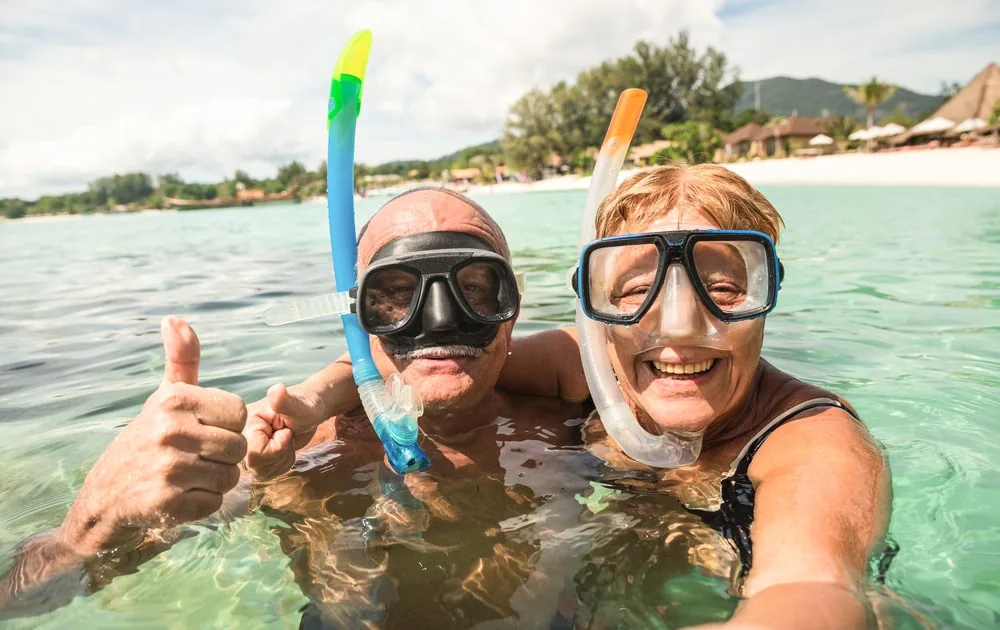
There’s no age limit on diving. More and more people over 60 are discovering the fascinating underwater world for themselves and enjoying unforgettable moments whilst scuba diving. A diving holiday combines adventure, nature and physical activity in a unique way. Modern diving schools and specialist tour operators have adapted to the needs of older divers and offer programmes that cater to both beginners and experienced divers. From leisurely dives in the Mediterranean to more challenging explorations in the Red Sea, there are plenty of opportunities to enjoy the underwater world at your own pace.
Key Takeaways
- Diving is possible even in later life provided you are in good health, and offers unique experiences of nature
- A diving medical examination is essential before starting diving training
- Specialised diving schools offer courses tailored to the needs of older beginners
- Popular diving destinations for seniors include the Mediterranean, the Red Sea and tropical destinations with good infrastructure
- Organised diving trips with professional guidance enhance comfort and safety
- Proper preparation and a realistic assessment of one’s own abilities are crucial
Why diving remains fascinating even in later life
Diving holds a special appeal for people of all ages. For seniors, it opens up a world full of new impressions and experiences that can enrich their lives.
The fascination of the underwater world
The underwater world offers sights and experiences that are impossible on land. Colourful coral reefs, exotic fish, mysterious wrecks and the special silence underwater create a unique atmosphere. Many divers find floating in weightlessness meditative and relaxing. The slow, controlled movements and conscious breathing can have a calming effect.
For people who have spent their entire lives on land, a whole new dimension opens up. Encountering marine life in its natural environment, the play of light and shadow underwater, and the diversity of underwater landscapes leave a lasting impression. Many older divers report that diving has given them a new passion that adds meaning to their lives.
Diving also makes it possible to explore places that few people ever get to see. Whilst other holidaymakers lie on the beach, divers discover hidden caves, impressive drop-offs or species-rich seagrass beds. This exclusivity and the feeling of experiencing something special contribute to the fascination.
Health considerations for diving in later life
Diving can be practised in later life provided one is in good health and performs it correctly. However, certain requirements must be observed. A thorough medical examination by a specialist diving doctor is essential before starting diving training. This examination determines whether there are any health restrictions that rule out diving or require special caution.
It is particularly important to check the cardiovascular system and lung function. Hearing and pressure equalisation in the ears also play a role, as pressure differences must be equalised whilst diving. People with certain chronic conditions such as severe high blood pressure, cardiac arrhythmia or epilepsy should not dive. However, the exact assessment is the responsibility of the diving doctor.
A positive factor is that many older people have years of experience in other sports and a good sense of their own physical condition. The physical fitness required for relaxed diving can be maintained or improved through regular exercise. Swimming, cycling or walking are good ways for older people to prepare for diving.
It is important to know and accept your own limits. Dives do not have to be deep or strenuous to be fascinating. Many of the most beautiful underwater landscapes are found at shallow depths, where there are fewer risks and dive times can be longer. A leisurely dive at a depth of eight to twelve metres can be just as fulfilling as deeper explorations.
Social experiences and community
Diving is a communal experience. You never dive alone, but always with a partner or in a group. This fosters social interaction and enables you to connect with like-minded people. The diving community offers valuable opportunities to build new social networks, particularly for seniors looking to do so after retirement.
In diving courses and on diving trips, people of different ages and backgrounds come together, united by a shared enthusiasm for diving. The underwater experiences create a special bond, and friendships often form that last beyond the holiday. The mutual trust and care for one another, which are a given when diving, strengthen the sense of community.
Many dive centres and schools foster a family-like atmosphere in which older beginners also feel welcome. The evenings spent together after the dives, when experiences are shared and photos shown, are often just as valuable as the dives themselves. This social aspect plays a key role in making diving more than just a sport.
Diving training and courses for older beginners
Anyone wishing to take up diving later in life needs thorough training. Various diving organisations offer courses tailored to different needs and learning speeds.
The path to a diving certificate
Basic diving training for recreational divers is standardised worldwide and comprises theoretical and practical elements. The best-known training organisations are PADI, SSI, CMAS and others. A beginner’s course leading to the first diving certificate typically consists of theory lessons, exercises in a pool or shallow water, and several open-water dives.
The theory covers the physical principles of diving, equipment handling, safety rules and how to behave in emergency situations. The practical exercises begin in calm, shallow water, where basic skills such as equalising, breathing through the regulator and handling the mask are practised. Only once these basics have been mastered are open-water dives undertaken.
For older beginners, it is important not to put themselves under time pressure. Some diving schools offer courses spread over a longer period, allowing more time for repetition. Private lessons or small-group tuition can also be useful for tailoring the pace of learning to individual needs.
Upon successful completion of the beginner’s course, you will receive an internationally recognised certification that entitles you to dive independently with a partner worldwide. This certificate is usually referred to as Open Water Diver or similar and allows dives to a certain depth, typically 18 metres.
Prerequisites and medical fitness for diving
A diving medical examination is required before the start of any diving training. This specialised examination goes beyond a standard health check and takes into account the specific requirements of diving. Diving doctors are medical professionals with specialised additional training who are familiar with the physiological aspects of diving.
The examination typically includes a detailed medical history, a physical examination, a stress ECG and a lung function test. Hearing and balance tests may also be carried out. Additional examinations may be advisable in the case of certain pre-existing conditions or for older individuals.
It is important to be open with the diving doctor about any health issues. This includes any medication taken regularly. Some conditions rule out diving altogether, whilst others simply require special precautions or restrictions on the depth and duration of dives.
The diving fitness examination should be repeated regularly. For people over 40, an annual repeat is usually recommended. This is for your own safety and ensures that any changes in health are detected in good time.
Specialist diving schools for seniors
Some diving schools and centres specialise in older beginners and offer particularly gentle and patient instruction. These schools take more time, repeat exercises more frequently and pay special attention to their students’ needs. The instructors often have many years of experience and know how to instil the necessary confidence even in anxious or uncertain beginners.
When choosing a diving school, various criteria should be taken into account. These include the instructors’ qualifications, the size of the groups, the quality and maintenance of the equipment, and the general atmosphere. Recommendations from other older divers can be helpful. You should also take the opportunity to speak to the instructors and view the facilities before booking.
Some diving schools offer special courses for seniors, where all participants are of a similar age. This can lower the barrier to entry and create a more pleasant learning environment. Others prefer mixed groups, where young and old can learn from one another. Which option is right depends on personal preferences.
The path to a diving certificate
Basic diving training for recreational divers is standardised worldwide and comprises theoretical and practical elements.
Prerequisites and medical fitness for diving
A diving medical examination is required before the start of any diving training.
Specialised diving schools for seniors
Some diving schools and centres specialise in older beginners and offer particularly gentle and patient training.
Popular diving destinations for seniors
The choice of diving destination has a significant impact on the holiday experience. Different regions offer varying advantages in terms of water temperature, visibility, biodiversity and infrastructure.
Mediterranean region
The Mediterranean is a popular starting point for European divers due to the short journey and good infrastructure. Countries such as Spain, Italy, Greece, Croatia and Turkey offer numerous diving centres and a wide variety of dive sites. Water temperatures are pleasant during the summer months, and most dive sites are also suitable for beginners.
The Spanish Balearic Islands, particularly Mallorca and Menorca, have well-established diving centres with German-speaking staff. The dive sites range from shallow bays to cave systems and wrecks. The Canary Islands are also of interest, although here the Atlantic Ocean can bring slightly cooler water temperatures and stronger currents.
Croatia has developed into a popular diving destination in recent years. The Adriatic offers clear water and an interesting underwater landscape featuring rocks, caves and historic wrecks. Many dive centres cater to older divers and offer relaxed dives without any rush.
Greece attracts visitors with its numerous islands and crystal-clear waters. The Cyclades and the Ionian Islands in particular are ideal for relaxed diving. The combination of a diving holiday and cultural attractions makes Greece an attractive destination for older travellers who appreciate variety.
Red Sea
The Red Sea is considered one of the best diving destinations in the world and can be reached relatively quickly from Europe. Egypt offers a superbly developed diving infrastructure with locations such as Hurghada, Sharm El Sheikh and Marsa Alam. Water temperatures are pleasant all year round, visibility is often excellent, and the biodiversity is impressive.
Particularly attractive to older divers are the many house reefs, which can be dived directly from the beach or jetty. This eliminates the need for long boat trips and allows dives to be tailored to one’s own pace. The shallow reef tops at low depths are home to an abundance of marine life and are ideal for relaxed, long dives.
Many dive centres on the Red Sea have years of experience with international guests and offer services in various languages. The hotels are geared towards divers and are often situated right on the reef. The opportunity to relax in air-conditioned rooms between dives is also much appreciated.
As an alternative to Egypt, Jordan also offers access to the Red Sea via Aqaba. The dive sites are less crowded, but the infrastructure is equally well developed. For more adventurous seniors, Sudan is also an option, although here dive safaris on liveaboard vessels are usually offered.
Long-haul destinations with good infrastructure
For more experienced divers or those who do not shy away from a longer journey, more distant destinations are also an option. A good tourist and medical infrastructure, as well as political stability, are important here.
The Maldives are a dream destination for many divers. The atolls offer spectacular dive sites with large fish, manta rays and whale sharks. Many resorts cater to higher standards and offer comfort and excellent service. The combination of luxury, stunning beaches and first-class diving makes the Maldives a special, albeit expensive, destination.
Thailand is also very popular and offers excellent value for money. Destinations such as Phuket, Koh Tao or the Similan Islands have a well-developed diving infrastructure. Thai hospitality and the diverse underwater world make the country attractive. However, the travel period should be chosen carefully to avoid the monsoon season.
The Caribbean also offers fantastic dive sites. Cozumel in Mexico, Bonaire or the Cayman Islands are known for their relaxed diving conditions and clear waters. The English-speaking infrastructure and good medical care are further advantages. For long-haul trips, the longer journey and possible time difference should be taken into account.
Practical planning for your diving holiday
Careful preparation plays a key role in ensuring a successful diving holiday. Various organisational and practical aspects deserve attention.
Travel arrangements and booking
Diving holidays can either be put together individually or booked as a package holiday. Specialised diving tour operators offer all-inclusive packages that cover flights, accommodation, meals and diving packages. The advantage of this is that all components are coordinated and a contact person is available in the event of any problems.
When choosing a hotel or resort, various factors should be taken into account. The location of the dive centre, the quality of the equipment, the qualifications of the instructors and the size of the dive groups are important criteria. The question of whether dives are conducted directly from the beach or by boat may also be relevant for older divers. Beach dives are often more relaxed and allow for flexible scheduling.
Recommendations from other divers are valuable. Online reviews and diving forums offer insights into the quality of various dive centres and hotels. You should also take the opportunity to communicate directly with the dive centre before booking to express any specific requests or concerns.
When planning your trip, you should allow plenty of time. A hectic schedule with dives every day can be exhausting. It is better to plan rest days when you can undertake other activities or simply relax. You should also allow time to acclimatise after arrival. Diving immediately after a long-haul flight is not recommended.
Gear and equipment
The question of whether to bring your own equipment or hire it locally arises on every diving holiday. For beginners, hiring is usually the more practical option. The equipment is heavy and bulky, and transporting it can be a hassle. Furthermore, you do not have to maintain and look after hired equipment yourself.
Most dive centres have modern, well-maintained equipment in various sizes. It is important that everything fits well and is comfortable. Masks, fins and wetsuits in particular should be chosen carefully, as poorly fitting equipment can make the dive uncomfortable. It is advisable to allow sufficient time for fitting the equipment before the first dive.
Some personal items of equipment, such as your own mask or a dive computer, can certainly be brought along if you already have them. A well-fitting, familiar mask significantly increases comfort. Owning your own wetsuit can also be a sensible investment if you dive frequently, as it can be perfectly tailored to you.
For the trip itself, good travel insurance that also covers diving accidents is recommended. Specialised diving insurance policies offer worldwide cover and, in an emergency, cover the costs of treatment and any necessary decompression treatments. These policies are affordable and provide additional peace of mind. Air travel in later life generally requires careful preparation and appropriate insurance.
Safety and precautions
Safety is the top priority when diving. This applies particularly to older divers, who may no longer be as resilient as they were in their younger years. The most important rule is never to push beyond your own limits. Anyone who feels unwell should abort the dive or not start it in the first place.
The buddy system, whereby divers always dive in pairs, is a fundamental safety rule. Your dive partner should be trustworthy and attentive. On organised dives with a guide, several divers can also dive together as a group. The guide knows the dive sites and ensures the safety of the group.
Before every dive, the equipment should be thoroughly checked. This is done systematically using a set checklist learnt during training. The buddy check, where diving partners check each other’s equipment, is also part of the routine. These checks may seem time-consuming, but they are essential for safety.
During the dive, it is important to adhere to the no-decompression limits and make safety stops. The dive computer displays the remaining no-decompression time and the current depth. Conservative settings on the computer increase safety. The breathing gas reserve should also be generous. It is better to surface with plenty of air in the tank than with an almost empty tank.
Certain rules should be observed after diving. You should not fly within 24 hours of your last dive, as the residual nitrogen in the body can cause problems due to the lower cabin pressure. Intense physical exertion or alcohol consumption immediately after diving is also not recommended. Drinking plenty of fluids helps the body to desaturate.
It is also important to watch out for signs of problems. Unusual tiredness, joint pain, skin changes or neurological symptoms after diving may indicate decompression sickness and require immediate medical attention. Most dive centres have the contact details of the nearest hyperbaric chamber and can respond quickly in an emergency. Health and well-being in later life should always be a priority, even when participating in sport.
Despite all precautions, diving remains an adventure sport with certain risks. These can be minimised through training, experience and sensible behaviour, but never completely ruled out. Those who accept these risks and act with due caution can safely enjoy diving well into old age. The reward is unforgettable experiences in a fascinating world accessible to only a few.
A diving holiday for seniors is more than just a sports holiday. It is a journey to new horizons, a challenge to oneself and an enrichment of life. The underwater world, with its beauty and diversity, is waiting to be discovered, and age should not be a barrier. With the right preparation, a realistic self-assessment and the necessary respect for the element of water, older people too can experience the fascination of diving and enjoy unforgettable moments underwater.