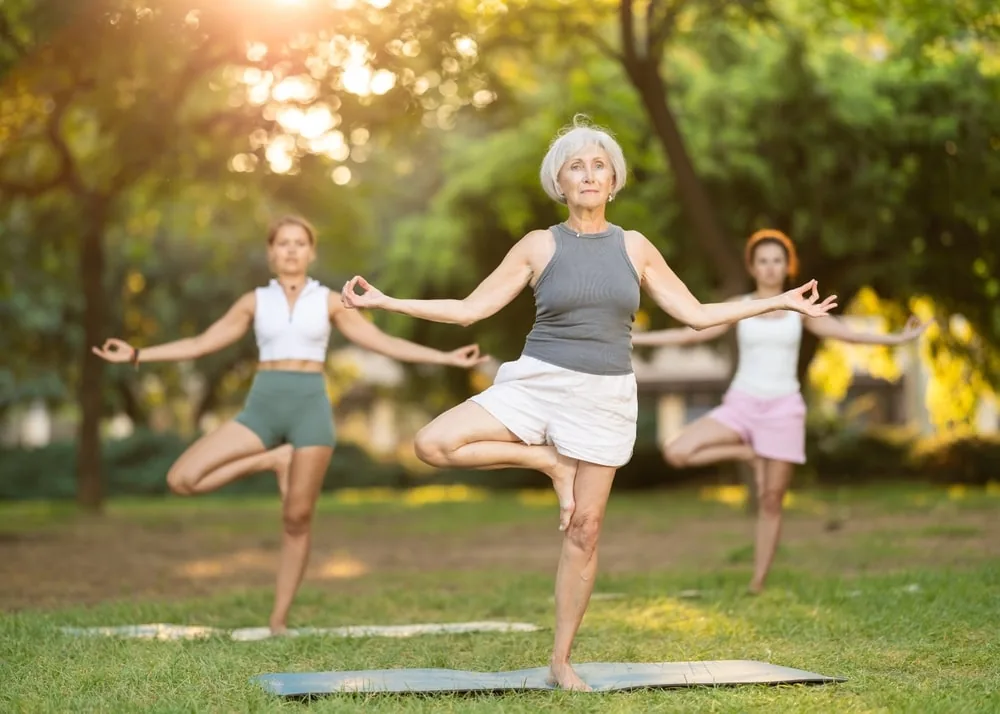
Yoga is becoming increasingly popular among older people, and for good reason. This centuries-old practice from India offers a gentle yet effective way to keep the body and mind fit as we age. Discover the benefits yoga can offer in later life, what to bear in mind when practising, and which exercises are particularly suitable.
Key Takeaways
- Yoga for seniors is an adapted form of traditional yoga, tailored to the physical capabilities of older people
- Regular practice can improve flexibility, balance, muscle strength and mental wellbeing
- A medical check-up should be carried out before starting, particularly if you have pre-existing conditions
- Aids such as chairs, blocks and straps make the exercises easier to perform and minimise the risk of injury
- Gentle yoga styles such as Hatha, Iyengar or chair yoga are particularly suitable
- Just 15 to 30 minutes a day can bring about positive changes
What is yoga for seniors
Yoga for seniors is a modified form of traditional yoga practice, specifically tailored to the needs and physical capabilities of older people. The focus is on slow, mindful movements that challenge the body without overloading it. Unlike more intensive forms of yoga, the emphasis is not on athletic performance, but on maintaining and improving flexibility, strength and inner balance.
The practice combines physical exercises, known as asanas, with breathing techniques and relaxation elements. Almost all exercises can be adapted to individual abilities. Those who find it difficult to practise on the floor can perform many positions whilst seated or with the support of a chair. This gentle approach makes yoga an ideal form of exercise for people of all ages, regardless of prior experience or fitness level.
Physical abilities naturally change with age. Muscles can weaken, joints can stiffen and balance may decline. Yoga offers a way to counteract these changes and maintain quality of life. It is never too late to start practising yoga.
Physical benefits
- Improved flexibility and mobility
- Strengthening of the muscles
- Better balance and coordination
- Pain relief for back problems
Mental benefits
- Stress relief and inner peace
- Improved concentration
- Greater zest for life and a sense of balance
- Social interaction within the group
Health benefits of yoga in later life
Regular yoga practice can have a wide range of positive effects on the health of older people. Scientific research suggests that yoga can support both physical and mental aspects of well-being.
Physical fitness and mobility
One of the most obvious effects of yoga is improved flexibility. Through regular stretching and lengthening, muscles can become more supple and joints more mobile. This can help to make everyday movements such as bending, turning or reaching easier.
Furthermore, yoga may help counteract age-related muscle loss. Many yoga poses require supporting one’s own body weight, which constitutes a gentle form of strength training. In particular, the deep muscles, which are important for posture, are engaged. Stronger muscles can in turn reduce back pain and improve posture.
Scientific evidence suggests that regular exercise through yoga may also have a positive effect on bone density. This could be particularly relevant for older people, who are at increased risk of osteoporosis.
Balance and fall prevention
A particularly important aspect of yoga for older adults is the improvement of balance. As we age, balance often deteriorates, increasing the risk of falls. Falls are among the most common causes of injury in older adults and can have serious consequences.
Yoga exercises specifically train the sense of balance, coordination and core strength. Many poses require maintaining balance on one or both legs, which promotes the interaction between muscles, sensory perception and the nervous system. Improved body awareness can help older people move more confidently and react more quickly to tripping hazards.
Mental health and stress relief
Yoga is more than just physical exercise. The practice also includes elements of meditation and mindfulness, which can have a positive effect on mental health. Many older people report that yoga helps them to find peace and reduce stress.
Focusing on breathing and movement can free the mind from worries and lead to greater inner balance. Scientific studies suggest that yoga may lower cortisol levels, a hormone associated with stress.
The social aspect of yoga should not be underestimated. Those who attend a class meet like-minded people and can make new friends. Social isolation in old age is a serious problem, and communal activities such as yoga classes can help to counteract this.
Improved respiratory function
Breathing exercises, also known as pranayama, are a central component of any yoga practice. These techniques aim to deepen, slow down and make breathing more conscious. As we age, lung capacity can decrease and breathing often becomes shallower.
Targeted breathing exercises can strengthen the respiratory muscles and potentially increase lung capacity. Deeper, more conscious breathing supplies the body with more oxygen, which can have a positive effect on the energy supply to all organs.
Flexibility
Regular stretching makes muscles more supple and joints more flexible, making everyday life easier.
Fall prevention
Targeted balance training improves balance and coordination, making walking safer.
Stress relief
Meditation and mindfulness lower cortisol levels, promoting inner peace and calm.
Breathing power
Pranayama exercises deepen breathing and strengthen lung capacity, providing more energy.
Special considerations for yoga in later life
Although yoga is generally suitable for people of all ages, there are a few specific considerations to bear in mind when older people wish to begin or continue practising.
Safety and medical advice
The most important principle in yoga is: listen to your own body. Pain is not a sign of progress, but a warning signal. Exercises should never be performed to the point of pain. If a position feels uncomfortable or causes pain, it should be stopped immediately or modified.
Before starting a yoga practice, it is advisable to have any pre-existing health conditions or chronic illnesses assessed by a doctor. This applies in particular to heart problems, high blood pressure, osteoporosis, joint conditions or following surgery. The yoga teacher should also be informed of any health restrictions so that they can adapt the exercises accordingly.
People with high blood pressure should exercise caution with exercises where the head is facing downwards. Such positions can further increase blood pressure and should only be held briefly or avoided altogether.
Aids and adaptations
One of the great advantages of yoga is that almost all exercises can be adapted to individual needs. Props play an important role in this and should be used without hesitation. They are not a sign of weakness, but enable a safe and effective practice.
Among the most useful aids are yoga blocks, which can help bring the floor closer when flexibility is limited. Straps make it possible to hold positions that would otherwise be unattainable. Cushions or pads can be placed under the knees or hips to relieve pressure. A thicker yoga mat offers greater comfort for sensitive joints.
Chair yoga as an alternative
For people who find it difficult to stand for long periods or practise on the floor, chair yoga offers an excellent alternative. In this form of yoga, the exercises are performed whilst sitting on a sturdy chair or standing with the support of a chair.
Chair yoga makes the practice accessible to people with limited mobility, joint problems or balance issues. The exercises can be just as effective as traditional yoga and offer similar benefits for flexibility, strength and relaxation.
Seek medical advice
Have any pre-existing health conditions checked before starting, particularly if you have heart, joint or blood pressure problems.
Use props
Blocks, straps, cushions and chairs enable safe practice; they are not a sign of weakness.
Listen to your body
Pain is a warning sign. Stop or adapt exercises immediately if you experience discomfort.
Choose a qualified teacher
An experienced teacher will correct poor posture and adapt exercises to suit individual needs.
Suitable yoga styles for older people
There are numerous different styles of yoga, and not all are equally suitable for older people. Gentler, slower forms are generally more suitable than intense, strenuous variations.
Hatha Yoga is a good place to start, as it combines basic postures with breathing techniques and is usually taught at a moderate pace. Iyengar Yoga places great emphasis on precise alignment and uses many props, making it particularly safe. Restorative Yoga focuses on relaxation and regeneration through holding supported positions for long periods.
Viniyoga is characterised by its adaptability and is often tailored individually to the practitioner’s abilities. Yin Yoga involves long, passive stretches and can be particularly beneficial for the joints.
Generally less suitable are very dynamic or hot forms of yoga such as Power Yoga, Ashtanga or Bikram Yoga, as these place high demands on the body and may carry a higher risk of injury.
Hatha Yoga
Basic postures combined with breathing techniques at a moderate pace, ideal for beginners.
Iyengar Yoga
Precise alignment using many props, particularly safe and gentle on the joints.
Chair Yoga
All exercises performed whilst seated or using a chair for support, perfect for those with limited mobility.
Recommended yoga exercises for older adults
There are a number of basic yoga poses that are particularly well suited to older people. These exercises are relatively easy to perform, can be modified if necessary, and offer a wide range of health benefits.
Exercises for flexibility and strength
The Mountain Pose, also known as Tadasana, is a basic standing position that appears simple but can have a significant impact. It improves posture, strengthens the leg muscles and promotes grounding. You stand upright with your feet together or slightly apart, your weight evenly distributed, your shoulders relaxed and your gaze directed straight ahead.
The Cat-Cow exercise gently mobilises the spine and releases tension in the back. On all fours, you alternate between rounding your back as you exhale and arching your back as you inhale. This flowing movement is particularly beneficial for people with back problems.
The shoulder bridge is a gentle backbend performed whilst lying down. It creates space in the upper body, strengthens the back muscles and can strengthen the pelvic floor muscles.
Balance exercises
The tree pose is a classic balance exercise. You stand on one leg, whilst the foot of the other leg is placed on the inside of the standing leg. To begin with, the foot can simply remain on the floor next to the standing leg. For safety, it is advisable to perform the exercise near a wall.
The one-legged stand is an even simpler variation. You simply stand on one leg for a few seconds and then switch to the other. This exercise can easily be incorporated into your daily routine, for example whilst brushing your teeth.
Relaxation exercises
The child’s pose is one of the most relaxing yoga positions. You kneel on the floor, sit back on your heels and lower your upper body forwards. This position soothes the shoulder and neck area and has a particularly relaxing effect. If you cannot bend down that far, you can place a cushion under your bottom.
The seated twist is a seated position in which the upper body is gently twisted to the side. This exercise massages the internal organs, promotes spinal mobility and can stimulate digestion. It can be performed on the floor or on a chair.
Mountain Pose (Tadasana)
Basic standing pose for better posture, leg strength and grounding.
Cat-Cow
A flowing spinal mobilisation in a four-legged position to relieve back tension.
Tree Pose
Classic balancing exercise on one leg, with a wall for support for beginners.
Child’s Pose
Deep relaxation for shoulders and neck, also with a cushion for support.
Regularity and social aspects
As with any form of exercise, the same applies to yoga: regularity is the key to success. The positive effects usually do not manifest immediately, but develop over weeks and months of continuous practice.
Interestingly, it is often more effective to practise more frequently for shorter periods than rarely for long sessions. Just 15 to 30 minutes a day can be enough to bring about positive changes. It is important to develop a routine and make yoga an integral part of your daily life.
For beginners, it is advisable to attend a class with an experienced yoga teacher. A qualified teacher can correct poor posture, suggest individual adjustments and help you perform the exercises safely.
Practising in a group also offers the benefit of social interaction. Interacting with other participants can be motivating and help build stamina. Shared activities foster social connections and can counteract feelings of loneliness. Many participants report that the social aspects of a yoga class are just as valuable as the physical exercises themselves.
Those who prefer to practise at home will now find numerous online courses, videos and apps specifically designed for senior yoga. These can be a good complement or alternative to in-person classes, particularly for people with limited mobility or those living in rural areas.
However, whilst regularity is important, it is also vital to listen to your own body and take breaks when necessary. Yoga should not be an additional burden, but rather an enrichment of life. The practice should feel comfortable and bring joy.