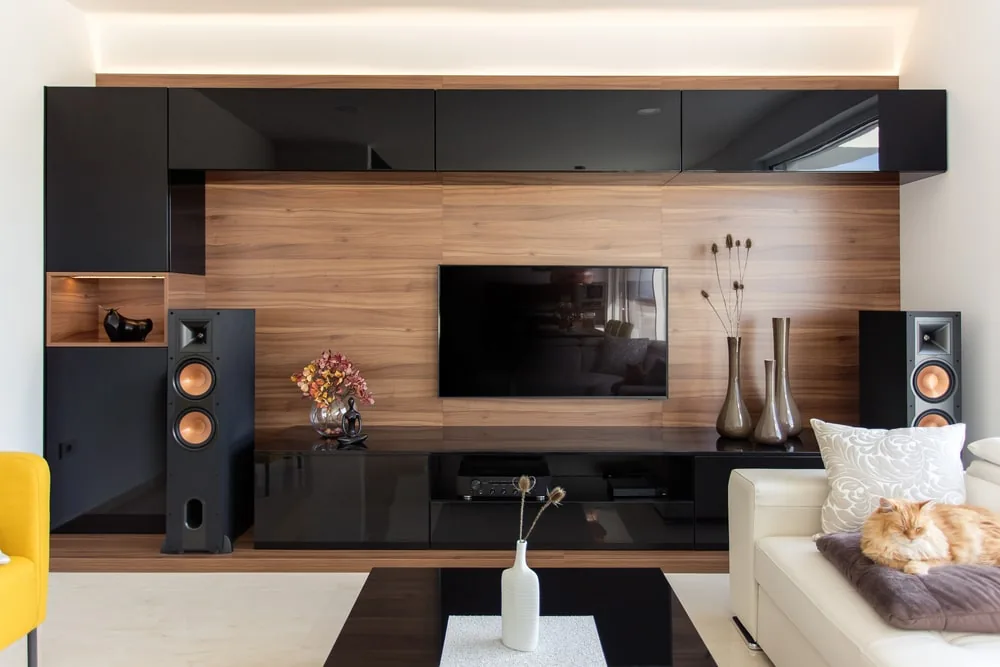
Choosing between a soundbar and a full-scale home cinema system is a challenge for many film and music enthusiasts. Both options promise a significantly better sound experience compared to a TV’s built-in speakers. But what exactly are the differences, and which system best suits your needs, available space and budget? Find out more here about the key features of soundbars and home cinema systems to help you make an informed decision.
Key Takeaways
- Soundbars offer a compact all-in-one solution that is easy to install and takes up little space
- Home cinema systems deliver true surround sound and greater precision through separate speakers
- Soundbars often simulate surround sound virtually, whilst home cinema systems produce it physically
- Soundbars are generally cheaper, whilst home cinema systems require a larger budget
- The soundbar is ideal for small rooms and minimalists, whilst the home cinema system is ideal for enthusiasts
- Home cinema systems offer more connection options and flexibility thanks to AV receivers
What makes a soundbar stand out
A soundbar is a slim, elongated speaker system that is usually placed directly beneath the TV. Its main purpose is to significantly enhance the often thin TV sound. Soundbars are compact and offer a straightforward solution for better sound without cluttering the room with lots of speakers. Many models feature built-in subwoofers or come with an external, wireless subwoofer to produce deeper bass. Modern soundbars also often support surround sound formats such as Dolby Atmos by reflecting sound or using special drivers to create a virtual soundstage. Installation is usually straightforward: a cable connects the soundbar to the TV, often via HDMI ARC or eARC, which also allows control via the TV remote.
What is a traditional home cinema system
A classic home cinema system consists of several individual speakers strategically placed around the room, a subwoofer for low frequencies, and an AV receiver that acts as the central hub. Typical configurations range from a 5.1 system with five satellite speakers and a subwoofer to more complex 7.1.4 systems, which additionally incorporate ceiling speakers for immersive 3D sound such as Dolby Atmos or DTS:X. These systems are designed to create a genuine, room-filling surround sound experience in which sounds can be perceived precisely from different directions. Home cinema systems generally require more space and more complex cabling, but in return offer the highest level of sound quality and flexibility. The AV receiver allows you to connect numerous sources such as Blu-ray players, games consoles or streaming devices and offers extensive options for customising the sound.
Sound differences between soundbars and home cinema systems
The sound comparison between a soundbar and a home cinema system is one of the key factors in the purchasing decision. A soundbar, even a high-quality model with virtual surround technology, can rarely match the immersion and precision of a genuine multi-channel home cinema system.
Sound quality and immersion
Home cinema systems with discrete speakers produce true surround sound, where each speaker reproduces a specific channel. This results in more precise sound localisation within the room and an immersive experience that makes you feel as though you are right in the middle of the action. For example, an aeroplane flying across the screen will also move sonically from front to back or over your head if appropriate ceiling speakers are present. The separation of the channels is physically achieved here. A soundbar, on the other hand, attempts to simulate this effect virtually, often through reflections from walls or special algorithms. Whilst this can be impressive with good soundbars, it remains a simulation and does not achieve the same spatial resolution and sweet spot as a carefully set-up home cinema system.
Dynamics and bass reproduction
Home cinema systems also often have the edge when it comes to dynamics and bass reproduction. Individual, dedicated speakers and a powerful subwoofer can move larger volumes of air, thereby producing deeper, more precise and more powerful bass. The separation of midrange and tweeter drivers into separate enclosures also enables clearer reproduction and less distortion at higher volumes. Soundbars are physically limited due to their more compact design, although external subwoofers offer a significant improvement here. For real-life film explosions or the full spectrum of a concert, a home cinema system is generally superior.
Music playback
For audiophile listeners who value high-quality music playback, a home cinema system with well-matched stereo speakers often offers the better solution. The spatial separation of the speakers and the ability to choose high-quality components contribute to a detailed and more precise soundstage. Whilst soundbars can also reproduce music well, they are primarily optimised for the film experience.
Space and setup - a question of space requirements
The amount of space available in the living room is a key factor when deciding between a soundbar and a home cinema system.
Space requirements of the soundbar
Soundbars are designed for compactness. They simply require a clear space in front of the TV or can be wall-mounted. An external subwoofer can usually be placed discreetly in a corner, as it communicates wirelessly with the soundbar. This makes soundbars ideal for smaller rooms, flats or minimalist interior styles where an extensive speaker setup is not desired. Cabling is also kept to a minimum.
Space requirements for a home cinema system
A home cinema system requires significantly more space and more careful planning. Several speakers (centre, front, surround, possibly ceiling) must be positioned optimally to realise the full surround sound potential. This means that free space must be found for the speakers, and cabling to each speaker is required, which should ideally be concealed. Whilst this can be integrated in a visually appealing way in larger rooms, in smaller rooms a full home cinema system can quickly feel overwhelming and force compromises in the setup that compromise the sound experience.
Cost overview
The price range for soundbars and home cinema systems is wide, and both systems can range from very affordable to extremely expensive.
Costs for a soundbar
Entry-level soundbars are available for under €100. These offer a simple improvement in sound quality compared to TV speakers. However, high-end models with advanced features such as Dolby Atmos, integrated streaming services or multi-room capability can easily cost 500 euros or more. Premium soundbars from manufacturers such as Sonos or Ambeo can even reach prices of over 1,000 euros. The advantage is that a soundbar allows you to achieve a quick and relatively cost-effective improvement in sound quality.
Costs for a home cinema system
The cost of a home cinema system comprises the AV receiver, the speakers (often sold as a set or individually), the subwoofer and, where applicable, cables and accessories. Entry-level 5.1 systems are available from around €500 to €800. There is virtually no upper limit. Sophisticated systems with high-end speakers and powerful AV receivers can cost several thousand euros. The investment here is generally higher than for a soundbar, but also offers correspondingly better sound quality and more expansion options.
Operation and connectivity
Operation and connectivity options are also important aspects that shape everyday use of the sound system.
Ease of use of soundbars
Soundbars are known for their ease of use. They can often be controlled via the TV remote control, thanks to HDMI ARC or eARC. Many models also come with their own remote control or can be operated via a smartphone app. Bluetooth and Wi-Fi are standard for wireless music streaming. Setup is usually self-explanatory and quick to complete.
Versatility of a home cinema system
A home cinema system with an AV receiver offers significantly greater versatility in terms of connection options. Multiple HDMI inputs for various sources, optical and coaxial inputs, USB ports and network functions for streaming services are standard. However, setting up an AV receiver can be more complex, particularly when it comes to room calibration and speaker configuration. Automatic calibration systems are often helpful here, as they optimally adapt the sound to the room acoustics. Control is usually via the receiver’s remote control or dedicated apps.
Which system is right for whom?
The choice between a soundbar and a home cinema system depends heavily on personal priorities.
Who is a soundbar the right choice for?
A soundbar is ideal for people looking for a simple, space-saving solution to significantly improve their TV sound. If you value a tidy living room, want to minimise cables and appreciate good value for money, a soundbar is an excellent option. It is also very well suited to smaller rooms or as a temporary solution. Furthermore, installation is incredibly simple and quick.
Who should choose a home cinema system
A home cinema system is the first choice for enthusiasts and audiophiles who want the best possible sound experience and are prepared to invest more space, effort and money to achieve it. Anyone looking for an immersive surround sound experience for films and games, who values precise sound localisation and powerful bass, will be happier with a full-fledged home cinema system. It often offers advantages for high-quality music playback too. The flexibility in component selection and the scope for expansion are further plus points.