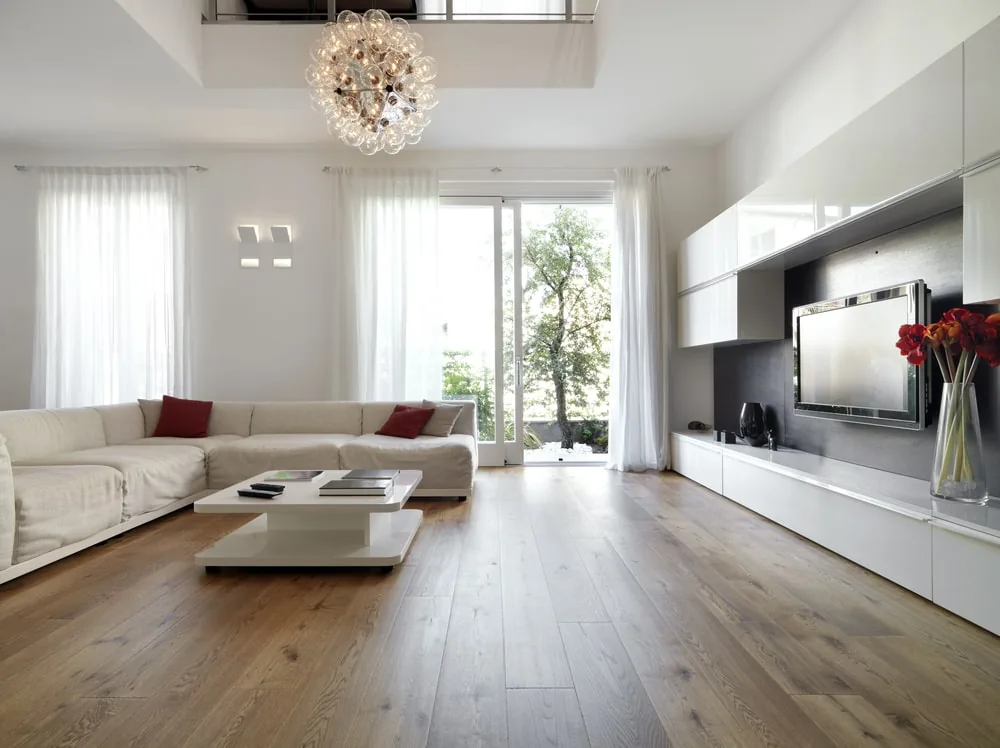
Choosing the right soundbar is more than just a matter of personal taste or budget. An often underestimated but crucial factor for an outstanding sound experience is the size of the room. The dimensions of a room have a direct influence on how the sound from a soundbar unfolds and is perceived. It is not about finding the loudest soundbar, but the one that harmonises perfectly with the acoustics of the living space in question.
A suitable sound system can significantly enhance your TV and music experience. When the soundbar is well-suited to the room size, the sound unfolds fully and clearly. The sounds reach the listener in a balanced and precise manner, whether it’s subtle dialogue, rich bass or dynamic sound effects. Careful matching of the soundbar to the room size ensures that the sound is reproduced not only powerfully, but also with nuance and detail. Ideal integration creates a harmonious overall look in the living room, both visually and acoustically.
Key Takeaways
- For small rooms (up to 15 m²), slim 2.0 or 2.1 systems with 50 - 150 watts are ideal, with a focus on clear speech reproduction.
- Medium-sized rooms (up to 25 sq m) benefit from 3.1 or 5.1 systems with at least 150 watts for improved dialogue and surround sound.
- Large rooms/open-plan living areas (up to 40 sq m+) require 5.1 systems or larger (e.g. with Dolby Atmos) and 300 watts+ to cover the entire space.
- The rule of thumb for the required power is around 10 watts per square metre of floor space.
- Placement (under the TV, unobstructed sound paths) and room acoustics (furniture, materials) are crucial for the final sound quality.
- Intelligent sound calibration automatically optimises the sound to suit the specific room conditions.
Small rooms, big sound: soundbars for compact living spaces
An impressive sound experience can also be created in compact living spaces. For smaller rooms, such as a guest room, a study or a cosy bedroom, it is important to choose a soundbar that is not oversized. Space-saving solutions are often the priority here.
Which soundbar is right for you?
For small rooms, typically up to 15 square metres, slim, compact models are ideal. These soundbars blend seamlessly into the décor without taking up much space. A rule of thumb suggests that soundbars should have an output of around 10 watts per square metre of floor space. For smaller rooms, soundbars with an output of 50 to 150 watts are therefore sufficient. These models already offer a surprisingly rich sound that fills small rooms perfectly without being overwhelming. The focus here is on clear speech reproduction and a balanced sound that significantly enhances films and TV series.
Advantages of 2.0 or 2.1 systems
2.0 or 2.1 systems really come into their own in small rooms. A 2.0 system offers two channels, left and right, for stereo sound. In smaller spaces, this is often sufficient to achieve a significant improvement over the TV’s built-in speakers. If a little more bass is desired, a 2.1 system is a good choice. Here, a separate subwoofer complements the two main channels and provides noticeable depth to the sound. These configurations are not only compact but also energy-efficient and easy to install, making them a practical solution for smaller living spaces. They deliver a well-rounded sound that creates an immersive audio experience on a small scale.
Space-saving solutions
Modern soundbars are often designed to blend discreetly into the living environment. Many models are slim-profile and can be placed directly beneath the TV or even mounted on the wall. With 2.1 systems, the subwoofers are sometimes so compact that they can easily be tucked away under a sofa or in a corner. This helps to keep the room tidy and ensures that the soundbar is not perceived as a disruptive element, but rather as a harmonious addition to the TV and the décor. Their easy integration and straightforward operation make these systems particularly attractive for anyone who values good sound in smaller living spaces.
Medium-sized rooms: the sweet spot for soundbar systems
Medium-sized rooms, such as a typical living room, are the most common setting for TV sound systems. Here, a wide range of possibilities opens up for creating a balanced and powerful sound experience. The room size allows for greater flexibility in choosing the soundbar configuration and power output.
Versatile options
For medium-sized living rooms up to 25 square metres, there is a wide range of soundbar models to suit different requirements and preferences. For this room size, a soundbar with a total power output of at least 150 watts is recommended to fill the room optimally. The choice here often depends on how immersive the sound experience should be and what type of content is mainly consumed. Whether it’s films, music or video games, there are suitable soundbars for every need that provide optimal sound coverage for the room. The performance of these devices is designed to fill a room of this size well with sound without the audio becoming distorted or lost.
Focus on 3.1 or 5.1 systems
In medium-sized rooms, 3.1 or 5.1 soundbar systems can really show off their strengths. A 3.1 system offers a dedicated centre channel in addition to the stereo channels. This channel is specially optimised for dialogue reproduction. The result is significantly improved speech intelligibility, which makes a big difference, particularly in films and series with a lot of spoken content. A 5.1 system is already capable of producing impressive surround sound. This utilises additional satellite speakers or integrated speakers within the soundbar to reproduce sound from the sides or from behind. This creates a more immersive sound experience that places the viewer right at the heart of the action. The spatial sound is noticeably expanded and the atmosphere of films is intensified.
The role of the subwoofer
In medium-sized rooms, a subwoofer is an essential component of the sound system. Whether it is an external, wireless subwoofer or one integrated into the soundbar, it delivers the necessary bass that is essential for a full and dynamic sound experience. Deep tones, explosions or musical bass notes are particularly effective with a good subwoofer. It also takes the strain off the soundbar’s main speakers, allowing them to reproduce clearer mid-range and high frequencies. The placement of the subwoofer can also influence the sound experience, with flexible positioning options often being advantageous for finding the best bass in the room. A well-coordinated interplay between the soundbar and subwoofer creates a harmonious and powerful audio experience.
Versatile options
For medium-sized living rooms up to 25 square metres, there is a wide range of soundbar models offering different...
Focus on 3.1 or 5.1 systems
In medium-sized rooms, 3.1 or 5.1 soundbar systems can really show off their strengths.
The role of the subwoofer
A subwoofer is an essential component of the sound system in medium-sized rooms.
Spacious rooms and open-plan living areas: maximum sound enjoyment
When equipping a large room or an open-plan living area with a soundbar, special demands must be placed on the performance and technology of the audio system. The aim here is to create a comprehensive soundscape that fills the entire space with rich and immersive sound.
High-performance soundbars for spacious environments
For spacious rooms measuring up to 40 square metres or more, soundbars with high power output and wider sound coverage are required. A total power output of 300 watts or more is recommended here to ensure an optimal sound experience. These models are designed not only to fill the room with sound effectively but also to deliver consistently high sound quality over greater distances. These are often larger soundbars or systems that use a combination of several separate speakers to achieve the desired coverage. The soundbar’s wattage plays a crucial role here, as it is an indicator of the maximum volume and the ability to effectively fill the room with sound.
Dolby Atmos and DTS:X for immersive surround sound
Technologies such as Dolby Atmos and DTS:X really come into their own in large rooms. These modern audio formats enable object-based surround sound, where sounds come not only from the front, sides or rear, but also from above. This is achieved through special upward-firing speakers in the soundbar or external up-firing modules. The result is an incredibly immersive surround sound that allows viewers to be completely enveloped in the world of the film. The sensation of being surrounded by sound greatly enhances the home cinema experience, particularly if the room is large enough to make optimal use of reflections from the ceiling. These technologies create a cinema-like atmosphere right in your own living room.
Expandable systems and multi-room capabilities
For very large or open-plan living areas, it may be worth investing in an expandable sound system. Some models allow you to add additional wireless rear speakers or further subwoofers to further optimise the surround sound and improve sound distribution throughout the room. Furthermore, many premium soundbars now offer multi-room capabilities, often via Wi-Fi or dedicated manufacturer apps. This means the soundbar can become part of a larger audio system in the home, where music or TV audio is played synchronously in different rooms. This creates a seamless sound experience and offers maximum flexibility for entertainment in large and open-plan living areas.
The importance of room acoustics and placement
In addition to the size of the room, the room’s acoustics and the strategic placement of the soundbar play a crucial role in the final sound experience. Even the best soundbar cannot reach its full potential if the environmental conditions are unfavourable.
Optimal soundbar placement
The ideal placement for a soundbar is usually directly beneath the television. This ensures that the sound appears to come directly from the screen, creating a coherent audiovisual experience. It is important that the soundbar stands on a stable, level surface and that the speakers are not obstructed by furniture or other objects. If the soundbar is wall-mounted, it should be positioned flush beneath the TV and the speakers should be able to radiate sound freely. For soundbars with up-firing speakers for Dolby Atmos, it is also crucial that no obstacles such as shelves or ceiling lights block the path of the sound waves to the ceiling, as these reflections are essential for the three-dimensional sound effect.
The influence of furniture and materials
The furnishings of a room have a significant influence on room acoustics. Hard surfaces such as glass, tiles or unplastered walls reflect sound strongly, which can lead to reverberation and imprecise sound. Soft materials, on the other hand, absorb sound. Curtains, carpets, upholstered furniture and bookshelves can help to reduce excessive reverberation and dampen the sound. A balanced ratio of reflective and absorbent surfaces is ideal. In a bare room, the sound can quickly become ‘hollow’ or ‘tinny’, whilst a cosily furnished room with plenty of textiles often has natural acoustics that benefit the sound. Small adjustments to the furnishings can often have a significant impact on optimising sound quality.
Avoiding obstacles
It is very important that the soundbar’s speakers have a clear path to the listening area. Any obstacles - be it a decorative item in front of the soundbar, a coffee table blocking the path to the lower drivers, or even plants placed too close - can negatively affect the sound. The sound should be able to spread freely throughout the room to achieve its full effect. It is therefore advisable to leave sufficient space in front of the soundbar. The positioning of people or objects directly in front of the soundbar can also impair sound reproduction by absorbing or deflecting the sound. An unobstructed sound path is the key to a clear and unadulterated sound experience.
Technical aspects that optimise sound in any room
Beyond the soundbar’s size and placement, there are a number of technical specifications and features that significantly contribute to a soundbar’s sound quality and can optimise its performance in different room environments. A deeper understanding of these aspects helps you make the right choice for your home cinema system.
Number of channels and their effect
The number of channels on a soundbar indicates how many separate audio channels it can reproduce. A 2.0 system offers stereo sound, ideal for music and basic TV enhancement in smaller rooms. A 3.1 system adds a centre channel for dialogue, which significantly improves speech intelligibility in films and TV series. 5.1 systems extend this with surround channels that create a wider soundstage, often via separate wireless rear speakers or virtualisation techniques. 7.1 or 7.1.2 systems add further surround channels or height channels (the .2 stands for two height channels). A higher number of channels is particularly advantageous in larger rooms, as it enables a more detailed and immersive sound experience. The additional channels fill the room better with sound and ensure more precise placement of sound effects, making the home cinema experience more intense.
Power (watts) and volume
A soundbar’s wattage is an indicator of its maximum output power and thus of its ability to reach a certain volume and effectively fill a room with sound. However, it is important to note that high wattage alone is no guarantee of good sound quality; the quality of the speakers and the system’s tuning are equally crucial. The rule of thumb of around 10 watts per square metre serves as a good starting point. For smaller rooms (up to 15 m²), 50 - 150 watts is sufficient; for medium-sized rooms (up to 25 m²), at least 150 watts is required; and for larger rooms (up to 40 m²), 300 watts or more is recommended. A soundbar with adequate power can deliver clear, distortion-free sound even at higher volumes, which is important for an immersive experience when watching films or listening to music.
Connections and compatibility (HDMI ARC/eARC, optical, Bluetooth)
A soundbar’s connections are crucial for its compatibility with the TV and other playback devices. HDMI ARC (Audio Return Channel) is the standard connection for most modern TVs and allows audio to be transmitted from the TV to the soundbar via a single HDMI cable. HDMI eARC (Enhanced Audio Return Channel) is an advanced version that supports higher bandwidths and uncompressed audio formats such as Dolby Atmos and DTS:X, which is essential for optimal surround sound in larger systems. An optical connection is a good alternative if the TV does not have an HDMI ARC port. Bluetooth enables wireless music playback from a smartphone or tablet. Wi-Fi connections are also becoming increasingly common and offer a more stable connection as well as multi-room functionality. The right connection options ensure seamless integration of the soundbar into your existing audio-video system.
Smart sound calibration
Many modern soundbar models feature intelligent sound calibration functions. These systems use microphones to analyse the room’s acoustics, including room size, furniture placement and the position of the listening area. Based on this data, the soundbar automatically optimises the sound settings to deliver the best possible sound. This may include adjusting equaliser settings, balancing individual channels or optimising bass reproduction. Automatic calibration is particularly useful as it allows even less technically savvy users to unlock the full potential of their soundbar and enjoy an optimal sound experience, regardless of the specific room conditions. This is a valuable tip for anyone looking for simple and effective sound optimisation.
Checklist for your purchase decision
- Measure the room size: Determine the exact dimensions of your room (length, width, height) to get a realistic estimate of the power required.
- Estimate required power (watts): Use the rule of thumb of 10 watts per square metre: for small rooms (up to 15 m²) 50 - 150 watts, for medium-sized rooms (up to 25 m²) at least 150 watts, and for larger rooms (up to 40 m²) 300 watts or more.
- Define your desired sound experience: Consider whether you primarily want to enhance dialogue, desire rich bass for films, or are aiming for an immersive surround sound experience.
- Number of channels and subwoofer requirements: For small rooms, 2.0 or 2.1 systems are often sufficient, whilst medium-sized and large rooms benefit from 3.1, 5.1 or even Dolby Atmos-compatible systems. Consider whether an external subwoofer is necessary to achieve the desired bass.
- Check connections: Ensure the soundbar offers the necessary connections (HDMI ARC/eARC, optical, Bluetooth, Wi-Fi) for your devices.
- Consider placement and acoustics: Plan where the soundbar will be positioned and how the room’s acoustics are affected by furniture and materials. Ensure there is a clear line of sight and unobstructed sound pathways.
- Smart features: Features such as automatic sound calibration can make setting up and optimising the sound much easier.
A suitable sound system enriches your home in many ways. It enhances your film-watching experience, brings music to life and turns every audio experience into a highlight. With the right soundbar, perfectly tailored to the size of your room, you can create your very own personal and immersive sound experience.